


If you have ever read a gelatin specification, you have seen the word Bloom. Gel strength, expressed as a Bloom value, is one of the most important specifications for food gelatin, yet it is often misunderstood. This guide explains what Bloom means, how it influences formulation performance, and how to select an appropriate value for gummies, desserts, and dairy products. Gel strength is an important part of texture control, but gelatin dosage, viscosity, formulation, and processing conditions must also be considered.
What Is Gel Strength?
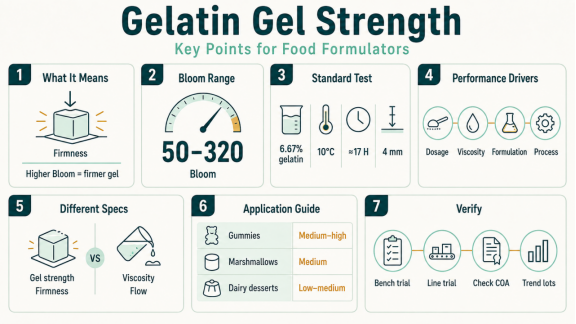
Gel strength is commonly expressed as a Bloom value. Under the standard test, a 6.67% gelatin solution is conditioned at 10 °C for approximately 17 hours, and the force required to depress the gel by 4 mm is measured in grams. That result is reported as the Bloom value. Commercial gelatin is available across a broad range of Bloom values, while Gelken gelatin is offered from 50–320 Bloom. Two products with the same Bloom value should show comparable gel firmness under the same test conditions, but they may still differ in viscosity and application performance.
Bloom Range and What It Means
At the same concentration and under comparable conditions, a higher Bloom value generally produces a firmer gel. Lower-Bloom grades can provide softer textures, while medium- to high-Bloom grades are often selected when greater gel firmness or elasticity is required, such as in confectionery. However, Bloom should not be treated as a stand-alone predictor of setting or melting behaviour. Gelatin source, concentration, formulation, and gel strength can all influence gelling and melting characteristics.
Gel Strength vs Gelling Concentration
A target texture can often be approached by balancing gel strength and gelatin dosage. A higher-Bloom grade may allow a lower dosage, while a lower-Bloom grade may require more gelatin to reach similar firmness. However, the relationship is not a universal linear formula: solids, sugar, acids, pH, processing temperature, and other ingredients also influence the final gel. Formulators should therefore compare dosage levels through bench and line trials rather than calculate a fixed dosage reduction from the Bloom value alone.
Gel Strength and Setting Temperature
Gel strength and gelling behaviour are related but should not be treated as the same specification. In comparable gelatin systems, a higher Bloom value can be associated with higher gelling and melting temperatures as well as faster gel formation. However, animal source, gelatin type, concentration, formulation, and processing conditions also matter. The characteristic melt-in-the-mouth quality of gelatin comes from this overall thermoreversible gel behaviour rather than from the Bloom value alone.
Gel Strength vs Viscosity: Different Specifications
A common mistake is assuming that a higher Bloom value automatically means higher viscosity. Gel strength and viscosity describe different functional properties and should not be used interchangeably. Two gelatins can have the same Bloom value but different viscosities, affecting pumping, mixing, depositing, foaming, or coating behaviour. Both properties are influenced by the gelatin's molecular-weight distribution, so manufacturers should evaluate and specify them separately whenever flow behaviour matters.
Choosing the Right Bloom for Your Application
| Application | Gel-strength guidance | Main consideration |
|---|---|---|
| Gummies / jelly sweets | Medium to high Bloom | Firm, chewy, quick-set on depositing |
| Marshmallows | Medium Bloom | Foam stability, elasticity and texture |
| Yogurt / dairy desserts | Low to medium Bloom | Smooth texture, stabilization and dosage |
| Panna cotta / mousse | Low to medium Bloom | Delicate, melts cleanly |
| Wine / juice clarification | Application-specific | Clarification efficiency, dosage, pH and gelatin type |
How Gel Strength Is Measured and Tested
Gel strength is measured under standardized conditions, allowing Bloom values to be compared when the same test method is used. For incoming material, check the CoA against your agreed specification and trend results across consecutive lots. A shift in Bloom value does not automatically mean a batch is defective, but unexpected variation should be investigated together with viscosity and application performance. When comparing suppliers, confirm that the test method and conditioning conditions are equivalent.
A Worked Example: Setting a Gummy Recipe
Suppose your current gummy formula uses a 200-Bloom gelatin at 6%. When evaluating a 250-Bloom grade, a lower dosage may achieve the target firmness, but 5% should not be assumed to be directly equivalent. Sugar solids, acids, gelatin viscosity, cooking conditions, and depositing temperature can all change the result. A better approach is to reduce the dosage stepwise in bench trials, then confirm texture and line behaviour before finalizing the commercial recipe.
Troubleshooting Texture With Gel Strength
When a product is too soft or too firm, gel strength is one of the first formulation variables to review, together with gelatin dosage and process conditions. In gummies, a higher Bloom value or increased gelatin dosage may increase firmness, but each option can affect viscosity, setting behaviour, and depositing differently. For desserts or other softer applications, reducing gel strength or dosage may help. Trending gel strength, dosage, viscosity, and key processing conditions together makes texture troubleshooting more reliable.
Gel Strength vs Other Specs to Watch
Bloom is the headline, but pair it with viscosity, moisture, pH, isoelectric point, and microbial limits. For products exposed to warm conditions, gelling and melting behaviour deserves particular attention
Frequently Asked Questions
Is a Higher Bloom Always Better?
No. A higher Bloom value generally gives a firmer gel at the same concentration, but it may also change gelling behaviour and require process adjustment. The best value is the one that meets the target texture, dosage, processing conditions, and finished-product requirements. Selecting a higher number without formulation testing does not automatically improve product quality.
Can I Substitute a Different Bloom Value?
Often, but not as a direct one-for-one substitution. A higher Bloom lets you use less powder for the same firmness, which can improve flavour release. But always re-test texture, set time, and line behaviour, because viscosity and process characteristics may differ between grades even at the same firmness.
Conclusion
Gel strength is the firmness dial of gelatin. Select a grade based on both the target texture and production requirements, and verify the agreed specification on the Certificate of Analysis. To evaluate a suitable grade, request a sample from Gelken's 50–320 Bloom edible gelatin range. For more background, explore our guides to what edible gelatin is and how it is made.
https://www.linkedin.com/in/xiaoji-ma-047029157/
https://www.facebook.com/eric.ma.549221

Post time: Aug-12-2026

