


How manufacturers source and qualify customized gelatin and collagen ingredients for their applications
Custom gelatin and collagen sourcing begins with translating an application requirement into a clear raw-material specification. Gel strength, viscosity, animal source, particle size, molecular-weight range, certification, packaging, and regulatory requirements can all affect product suitability, cost, and lead time. This guide explains a typical customization process from the initial application brief through sampling, qualification, and commercial supply.
Step 1: Define the Application Requirements
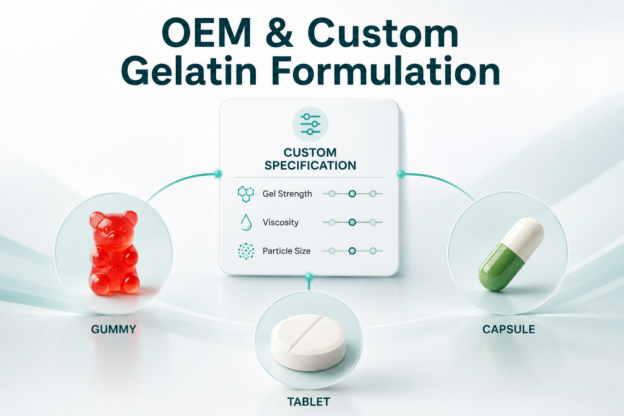
Start with the intended application and production conditions. Is the gelatin required for gummies, marshmallows, dairy products, hard or soft capsules, tablets, or another process? For collagen peptides, define whether the material will be used in powders, beverages, functional foods, or supplements. Share the target texture, processing conditions, dosage, regulatory market, and any animal-source restrictions with the supplier.
Step 2: Select the Raw-Material Type and Grade
Choose the gelatin or collagen peptide grade that matches the application. For gelatin, key parameters may include animal source, gel strength, viscosity, particle size, clarity, and microbiological requirements. For collagen peptides, source, protein content, molecular-weight profile, solubility, particle size, and sensory characteristics may be more relevant. Certification and destination-market requirements should be defined separately.
Step 3: Define the Custom Specification
Translate the application requirements into an agreed ingredient specification. For gelatin, this may involve selecting a target gel-strength and viscosity range, particle size, animal source, colour or clarity requirements, and applicable quality limits. For collagen peptides, molecular weight, protein content, solubility, source, and sensory targets may be defined. Request a representative sample before confirming the commercial specification.
Tip: define the acceptable specification range before asking for final pricing. Unnecessary customization can increase qualification time, production complexity, and cost without improving application performance.
Step 4: Agree on Specifications and Quality Standards
Document every critical quality attribute: appearance, odor, moisture, protein content, microbial limits, heavy metals, dissolution, and shelf life. Align on testing methods, sampling plans, and acceptance criteria before production begins.
Step 5: Run Pilot and Scale-Up Batches
A pilot batch validates that the lab formula performs on production equipment. Use this stage to refine mixing time, temperature profiles, filling weights, and packaging settings. Scale-up should follow a documented protocol with checkpoints at each volume increase.
Step 6: Confirm Packaging and Documentation
Confirm the commercial packaging, product label, lot identification, and supporting documents before ordering. Gelken's standard gelatin packaging is 25 kg per bag, with an inner PE liner and outer industrial bag; other requirements should be confirmed separately. Depending on the destination market, documentation may include the specification, COA, animal-source information, Certificate of Origin, veterinary documentation, or relevant certification.
Step 7: Quality Release and Logistics
Before shipment, confirm that the supplied lot meets the agreed specification and review the corresponding Certificate of Analysis. Required regulatory or export documents should also be checked against the destination market. Commercial terms—including MOQ, lead time, Incoterm®, storage conditions, and delivery schedule—should be agreed before the order is finalized.
Customization and Supply Items to Confirm
| Service | What to clarify |
|---|---|
| Specification & sampling | Target parameters, representative sample, trial quantity and lead time |
| Customization scope | Gel strength, viscosity, particle size, source or other agreed parameters |
| Compliance documents | COA, specification, animal-source, Halal/Kosher and destination-market documents |
| Packaging & labeling | Standard packaging, lot label and any confirmed custom requirement |
| Quality & logistics | Test methods, MOQ, lead time, storage, Incoterm® and delivery schedule |
Key Takeaways
A successful gelatin or collagen project depends on clear specifications, transparent communication, and staged validation from lab sample to commercial batch. Choose a partner with documented quality systems, flexible formulation support, and experience in your target market. Gelken supports customers from raw material selection through finished-product release.
About the author

Post time: Sep-04-2026

