


A practical guide for food technologists and production managers on selecting a gelatin grade, establishing a starting dosage, preparing the solution, and controlling the process for consistent results.
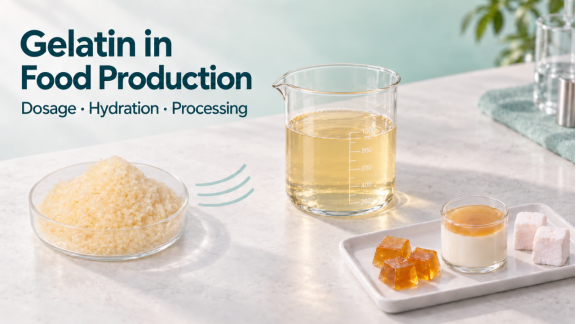
Gelatin’s Role in Modern Food Production
Gelatin functions as a gelling agent, stabilizer for aerated systems, water binder, film former, and clarifier in selected beverages. Its performance depends on grade, concentration, formulation, dispersion, thermal history, and cooling. Food technologists should therefore connect raw-material selection with a repeatable preparation procedure. This guide follows that sequence moves from gel strength, through hydration and dissolution, to application dosage, scale-up, and finished-product evaluation.
Understanding Gel Strength Before You Set the Dosage
Gel strength, commonly expressed as a Bloom value, describes the strength of a standardized gelatin gel and is an important starting parameter. Under comparable conditions, a higher-gel-strength grade can generally produce a firmer gel and may allow a lower use level. Final performance also depends on concentration, viscosity, pH, sugars and salts, thermal history, cooling, and target texture. A change from 120 Bloom to 250 Bloom should therefore be evaluated through formulation trials rather than treated as a direct gram-for-gram substitution.
Selecting a Hydration and Dissolution Method
Gelatin should be dispersed, hydrated, and dissolved to prevent persistent agglomerates and produce a uniform solution. A conventional method is to distribute the powder in cold water, allow the particles to hydrate, and then heat sufficiently to dissolve. Depending on the grade and equipment, manufacturers may instead premix gelatin with dry ingredients, disperse it directly into heated liquid under controlled agitation, or use a specially processed instant grade. Suitable liquid ratio, hydration time, temperature, and agitation depend on particle size, concentration, equipment, formulation, and supplier guidance.
- Dispersion: add gelatin at a controlled rate with enough agitation to keep the particles separated.
- Hydration: allow sufficient time for the selected particle size and concentration; define the endpoint rather than relying only on a fixed number of minutes.
- Dissolution: use the temperature needed to obtain a uniform solution while limiting unnecessary high-temperature holding.
- Formulation sequence: establish when acids, sugars, salts, and other hydrocolloids are added, since they can change hydration, viscosity, gelation, and thermal sensitivity.
- Hold control: document solution temperature and holding time so that gel performance and microbiological control remain consistent.
Dosage Guidelines by Application
Gelatin dosage is application-specific. The table provides preliminary formulation references, but the calculation basis should be clear and the final level confirmed against the selected grade, total solids, pH, other hydrocolloids, process, and target texture. Beverage clarification is evaluated through fining trials rather than against a finished-product texture target..
| Application | Illustrative starting range* | Main factors to validate |
|---|---|---|
| Gummies / jelly candies | 5–10% | Gel strength, viscosity, solids, depositing and target chew |
| Marshmallows | 1.5–3% | Whipping conditions and final structure |
| Gelled desserts / panna cotta | 1–2.5% | Serving temperature, solids and desired firmness |
| Mousses / aerated desserts | 0.5–2% | Foam stability, fat content and refrigeration |
| Meat products / aspics | 1–5% | Broth, salt, water binding and sliceability |
| Beverage clarification | Trial-determined; often ppm-scale | Tannin or haze load, settling and filtration |
*Illustrative ranges are generally expressed against the total formulation unless otherwise specified. Confirm the calculation basis and validate the final dosage in the intended process.
Scaling Dosage to Your Process
The ingredient quantity may be scaled mathematically, but equivalent performance also requires comparable mixing, heat transfer, holding, depositing, and cooling conditions. Before commercial production, test at a representative scale and document the addition sequence, dispersion method, hydration endpoint, solution temperature, holding time, shear, and cooling profile. Incorporate these parameters into the production standard and review them alongside finished-product texture data.
Process Variables to Control in Production
- Use a dispersion method and agitation level that prevent persistent agglomerates.
- Control solution temperature and holding time, particularly when the formulation is strongly acidic or alkaline.
- Reconfirm dosage and finished texture whenever gel strength, viscosity, source, or grade changes.
- Maintain a defined water-quality specification and investigate ionic or mineral variation when clarity or texture shifts.
- Define the cooling, setting, and storage conditions required for the intended gel structure.
- Include pH, acid-addition sequence, total solids, and other hydrocolloids in formulation trials.
Tips for Consistent Results
Consistent gelatin performance requires control of both the incoming material and production process. Seasonal conditions, raw-material variation, and changes in solution preparation or cooling can cause texture drift. The following records help teams distinguish ingredient variation from process variation.
- Standardize the water specification and starting temperature across shifts and sites.
- Weigh gelatin by mass and verify dispensing equipment at the required batch scale.
- Record the grade, lot number, gel strength, viscosity, and other relevant COA results.
- Train operators on the validated dispersion and solution-preparation method for the selected grade.
- Record solution holding, cooling, setting, and storage conditions together with finished-product texture results.
Matching Gelatin to Your Product
Gelatin selection should weigh gel strength together with viscosity, particle size, animal source, solution preparation, color or clarity, and the applicable food-quality specification. Where Halal, Kosher, or other certification is required, confirm that it covers the selected product, manufacturing site, and validity period. The supplier brief should include the application, formulation, target texture, equipment, destination market, and source restrictions so that a representative grade can be sampled and qualified.
Gelken supplies food-grade gelatin for confectionery, desserts, dairy products, and other food systems. Customers can discuss the required animal source, gel strength, viscosity, particle size, quality specification, and certification status. Based on the application and process information provided, Gelken can help identify a suitable starting grade and sample for evaluation in the customer’s formulation.
Frequently Asked Questions
Q: Does powdered gelatin always require cold-water hydration?
A: Cold-water hydration followed by warming is a widely used method for conventional gelatin powder, especially at higher concentrations. Depending on the grade and equipment, manufacturers may also use dry premixing, controlled hot dispersion, or an instant gelatin designed for another preparation method. Follow the supplier’s guidance and validate the selected process.
Q: What should I consider when changing to a higher-gel-strength grade?
A: At the same concentration and under comparable conditions, a higher-gel-strength grade will generally produce a firmer gel. However, the new dosage should be established through trials that also consider viscosity, formulation solids, pH, process temperature, and target texture rather than through a Bloom-value conversion alone.
Q: Which variables should I check when a gelatin gel shows syneresis?
A: Review gelatin concentration, total solids, pH, salts, other hydrocolloids, dissolution and holding history, cooling and setting conditions, and storage temperature. Comparing these records with a satisfactory batch can help identify whether the change originated in the formulation, raw material, or process.
Q: How should water quality be controlled?
A: Establish a consistent water specification covering relevant parameters such as hardness, mineral or ionic content, pH, temperature, and microbiological quality. When texture or clarity changes, compare the water results with the normal production range and confirm any adjustment through a formulation trial.
Key Takeaways
- Gel strength is an important dosage parameter, but final performance also depends on viscosity, concentration, formulation, and process conditions.
- Select and validate a dispersion, hydration, and dissolution method that matches the gelatin grade and production equipment.
- Use application ranges as development references, then confirm the dosage and process at a representative production scale.
- Combine COA review with controlled weighing, water specification, thermal history, cooling, and finished-product texture records.

Post time: Sep-09-2026

