


A practical RFQ framework for receiving accurate and comparable gelatin quotations
Getting a useful gelatin quotation involves more than asking for a price per kilogram. Without sufficient information, quotations may be based on different specifications, Incoterms, packaging, quantities, or lead times, making comparison difficult. A well-structured Request for Quotation (RFQ) reduces back-and-forth and helps suppliers price against the buyer's actual technical and commercial requirements. This article provides a practical RFQ template and explains the information procurement teams should include.
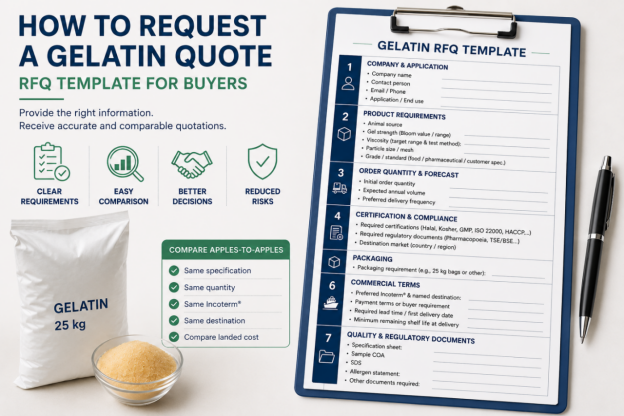
Why RFQ Structure Matters
Gelatin is a specification-driven ingredient. Two quotations with the same gel strength and viscosity can still differ in animal source, particle size, microbiological limits, certification, packaging, and commercial terms. A clear RFQ helps suppliers quote against the same technical and commercial baseline, allowing buyers to identify meaningful price differences rather than differences caused by mismatched requirements.
Core Information Every Gelatin RFQ Should Include
- Company and application: intended use such as confectionery, dairy, capsules, softgels, nutraceuticals, or other industrial applications.
- Order quantity and forecast: initial order quantity, expected annual volume, and preferred delivery frequency.
- Animal source and gel strength: e.g., bovine, porcine, or fish gelatin with the required Bloom value or acceptable range.
- Certification and compliance requirements: Halal, Kosher, GMP, ISO 22000, HACCP, applicable pharmacopoeia, and TSE/BSE documentation where relevant.
- Packaging: standard 25 kg industrial bags or any specifically required packaging format.
- Delivery terms: preferred Incoterm and named port, airport, or destination.
- Quality and regulatory documents: specification sheet, sample COA, SDS, allergen statement, animal-source documentation, and other market-specific documents as required.
- Target price range: optional; provide it only when there is a genuine commercial target or approved budget.
Sample Gelatin RFQ Template
1. Buyer Information
- Company name, contact person, email, phone
- Industry: food / pharma / nutraceutical / cosmetics
2. Product Requirements
- Animal source: [bovine / porcine / fish]
- Gel strength: [e.g., 150, 200, 250]
- Viscosity target: [mPa·s, if known]
- Particle size / mesh: [e.g., 8-60 mesh]
- Grade / standard: [food / pharmaceutical / customer specification]
3. Volumes and Schedule
- Trial quantity: [kg]
- Estimated annual volume: [kg or MT]
- First delivery date and frequency
4. Certifications and Compliance
- Required certifications: [Halal / Kosher / GMP / ISO 22000 / HACCP / other]
- Required regulatory documents: [pharmacopoeia / TSE-BSE / animal-source / other]
- Destination market: [country or region]
5. Commercial Terms
- Preferred Incoterm and named destination
- Payment terms or buyer requirement
- Required lead time / first delivery date
- Minimum remaining shelf life at delivery
How to Compare Quotes Apples-to-Apples
Create a comparison matrix covering product specification, quoted quantity, Incoterm, freight, packaging, certification or documentation requirements, lead time, payment terms, and sample policy. Compare landed cost where possible rather than mixing EXW, CIF, and delivered quotations. A lower unit price may not remain lower once different logistics and commercial conditions are normalized.
Red Flags to Watch
- A quotation that does not clearly identify the offered grade, gel strength, viscosity, animal source where required, or other agreed specifications.
- Unable to provide a specification sheet, representative COA, or required certification documents during supplier qualification.
- A price significantly below comparable quotations without a clear difference in specification, quantity, Incoterm, or commercial terms.
- A price significantly below comparable quotations without a clear difference in specification, quantity, Incoterm, or commercial terms.
Key Takeaways
A well-structured RFQ makes gelatin quotations easier to compare and reduces unnecessary clarification during sourcing. Include the intended application, gel strength and other critical specifications, order quantity, certification or compliance requirements, packaging, destination, and delivery terms. A complete response to these requirements is one useful indicator of a supplier's commercial and technical readiness, but it should be considered together with qualification data, documentation, sample performance, and supply capability.

Post time: Aug-20-2026

