


A buyer’s checklist for qualifying a pharma gelatin partner on quality, compliance, continuity, and total cost of ownership.
The Supplier Choice Is a Quality Decision
In pharmaceuticals, an excipient supplier is an important part of your quality and supply chain controls. The gelatin you buy becomes part of a drug product, so your organization must be able to demonstrate appropriate supplier qualification, traceability, and quality controls. Choosing a pharmaceutical-grade gelatin supplier is therefore less a procurement exercise and more a qualification process. The right choice supports consistent release, smoother audits, and supply continuity; the wrong one can contribute to out-of-specification investigations, import issues, and production delays that outweigh any unit-price saving.
Start With Compliance, Not Price
The first filter is documentation. A supplier should be able to demonstrate pharmaceutical-grade manufacturing, applicable quality certifications, and documentation that supports the intended market and application. For pharma buyers, documentation is not an administrative burden; it is part of supplier qualification.
- Evidence of GMP-compliant pharmaceutical manufacturing, supported by applicable site certifications or regulatory documentation rather than food-safety credentials alone.
- Pharmacopeial alignment (USP/EP/JP/ChP) with monograph-referenced CoAs.
- BSE/TSE statements and country-of-origin declarations for bovine material.
- Auditable batch records and change-control processes you can inspect.
- Stability or retest data supporting your finished-product shelf life.
If a supplier leads the conversation with price and trails it with documentation, reverse the order. For pharma, compliance is the product.
Quality System Depth
Certificates are necessary but not sufficient. The difference between a dependable partner and a risky one shows up in how their quality system actually operates day to day. Probing this separates suppliers who will pass your audit from those who will fail it six months in.
| Capability | What strong suppliers demonstrate |
|---|---|
| Batch consistency | Tight control of gel strength, viscosity, and purity across lots over time. |
| Change control | Formal notification before any process, site, or material change. |
| Deviation management | Documented root-cause and CAPA when something goes wrong. |
| Traceability | Lot-level links from raw material to finished bag, retrievable on demand. |
| Audit readiness | Willingness to host your audit and share quality metrics transparently. |
Technical Support That Earns Its Place
Pharmaceutical formulations are unforgiving, and grade selection drives dissolution, compatibility, and release. A supplier that merely ships what is in stock leaves you to solve problems alone. A partner helps you select the right gel strength and viscosity for your capsule type and route of administration, troubleshoots compatibility with your API, and provides formulation guidance that shortens your development cycle. That technical depth is part of the value you are actually buying.
Ask Before You Commit
- Which pharmacopeial monographs do your grades conform to, and can you prove it per lot?
- What is your change-control policy if you alter source, process, or site?
- Can you provide BSE/TSE and country-of-origin documentation for every bovine lot?
- What technical support do you offer during our formulation and scale-up?
- How do you handle a non-conforming lot — replacement, root cause, CAPA, and notification timelines?
Supply Continuity and Risk
A qualified supplier that cannot deliver is still a supply risk. For a line-critical excipient, continuity should be a core selection criterion. Evaluate not just current capacity but also supply resilience: Does the supplier maintain appropriate raw-material inventory, qualified backup arrangements, or sufficient production capacity to support your demand? Where a product is single-sourced, establish an appropriate contingency plan based on your risk assessment.
Qualify at least one backup supplier, even if you concentrate volume with a primary. Continuity is insurance you hope never to use but cannot afford to lack.
Total Cost of Ownership, Not Unit Price
The purchase order price is the smallest part of what gelatin truly costs. A cheaper lot that fails release testing, arrives late, or triggers a deviation costs far more than a premium lot that sails through. Buyers who evaluate total cost of ownership — including quality failures, expedited freight, audit effort, and line stoppages — consistently choose the more reliable supplier, because reliability is where the money actually is.
- Cost of a failed lot: retesting, scrap, deviation investigation, and possibly recall.
- Cost of delay: expedited freight or idle production lines.
- Cost of poor support: longer development and slower time to market.
- Cost of audit friction: internal effort and findings from weak documentation.
- Cost of switching later: re-qualification time and risk if you choose wrong now.
A Practical Qualification Checklist
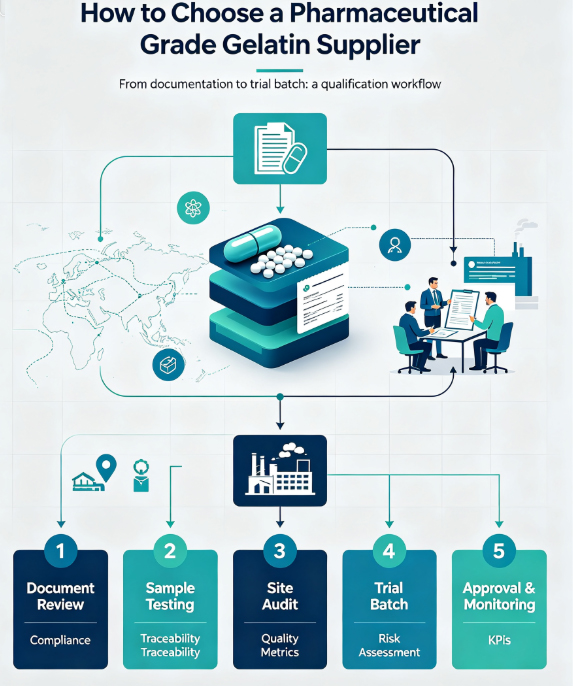
Bring structure to the decision. A staged qualification — document review, sample testing, site audit, and a trial batch — converts a gut feel into a defensible supplier approval that satisfies your QA and regulators alike.
| Stage | What to do |
|---|---|
| Document review | Collect GMP cert, monograph CoAs, BSE/TSE, and audit history. |
| Sample testing | Independently test a sample against your specification before approval. |
| Site audit | Verify facilities, quality systems, traceability, and relevant manufacturing controls through an appropriate supplier audit. |
| Trial batch | Run a small production lot to confirm performance in your real process. |
| Approval & monitoring | Approve with KPIs; monitor lots and re-audit on a fixed cadence. |
Gelken manufactures pharmaceutical gelatin under a GMP-certified quality system and offers grades for pharmaceutical applications with documented specifications and quality support. Its pharmaceutical gelatin range includes grades for capsules, tablets, microencapsulation, and medical applications, with specifications available for customer requirements. Request our pharmaceutical gelatin information and qualification documents to evaluate suitability for your application.
Frequently Asked Questions
Q: What is the minimum documentation I should require?
A: Applicable GMP or regulatory documentation, pharmacopeial CoA where applicable, BSE/TSE documentation for relevant animal-derived materials, country-of-origin information, and appropriate traceability records.
Q: How important is technical support?
A: High. Gelatin specifications can influence processing and product performance together with formulation and process variables. Appropriate technical support can help reduce development and scale-up risks.
Q: Should I qualify a backup supplier?
A: Yes. Continuity is critical for line-critical excipients; a backup protects against single-point failure.
Q: Why not just choose the lowest price?
A: Because total cost of ownership — failures, delays, audits, and re-qualification — usually makes the cheap lot the expensive one.
Key Takeaways
- For pharma, the supplier is part of your quality system — qualify on compliance first.
- Evaluate quality-system depth: consistency, change control, traceability, audit readiness.
- Prioritize technical support and supply continuity alongside unit price.
- Use total cost of ownership and a staged qualification to choose defensibly.

Post time: Sep-05-2026

