


Hard Capsule Gelatin: Specifications for Empty Capsule Manufacturers
Two-piece hard capsules are widely used for pharmaceutical, supplement, and nutraceutical formulations in the form of powders, granules, pellets, and selected non-aqueous fills. Each capsule begins as a controlled gelatin solution deposited on precision stainless-steel mould pins. For capsule manufacturers, gelatin is a critical raw material because its gel strength, viscosity, purity, and batch consistency directly influence film formation and shell performance. This guide explains the specifications that matter most when qualifying gelatin for a hard-capsule production line.
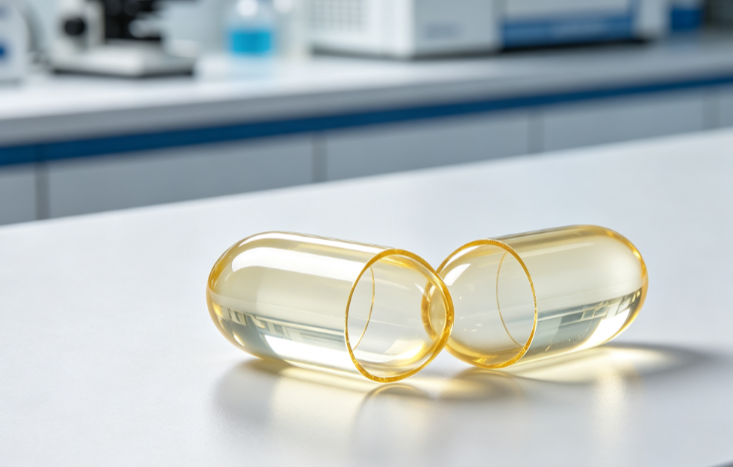
Why Capsule Makers Care About Gelatin Quality
As a critical raw material in precision hard-capsule manufacturing, gelatin influences wall thickness, brittleness, lock strength, and disintegration behaviour, together with mould-pin design, dipping conditions, drying, and other process variables. A slightly off-spec batch does not just look different — it can raise cap-body separation defects, slow your dipping line, or fail a dissolution test at the pharmaceutical lab. Because a capsule manufacturer may run millions of units per batch, even a fraction-of-a-percent defect rate becomes a costly recall or rework event. That is why the gelatin spec is treated as a controlled raw material, qualified and trended like any other pharmaceutical excipient.How Hard Capsules Are Made
In the standard dipping process, paired sets of shaped pins are lowered into a warm gelatin bath. A film forms on the pins, is partially dried, stripped, trimmed, and the body and cap are joined. The thickness, elasticity, and drying behaviour of that gelatin film depend almost entirely on the raw material's rheology. Two gelatins with the same nominal Bloom can still behave differently during dipping if viscosity, moisture, or isoelectric point diverge — which is why capsule makers qualify suppliers on a full specification, not a single number. The dipping step is repeated to build the desired wall thickness, then the caps and bodies are dried in a controlled tunnel to a precise residual moisture. Temperature and humidity in that tunnel interact with the gelatin's moisture and Bloom, so a change in gelatin grade often forces a re-tuned drying profile. Getting the gelatin right upstream is what keeps the downstream line stable.Key Gelatin Specifications for Hard Capsules
Below are the parameters empty-capsule manufacturers should lock down in every purchase specification:| Parameter | Why it matters for capsules | Typical target |
|---|---|---|
| Bloom (gel strength) | Higher Bloom = firmer film, thinner walls possible, faster set | 150–250 g |
| Viscosity | Controls pin coating, drainage, shell weight, and dimensions | 2.5–4.5 mP·s (6.67%) |
| Moisture | Affects brittleness, storage, and drying tunnel profile | 8–12 % |
| Ash content | Indicates mineral purity post-extraction | ≤2.0 % |
| pH | Influences clarity, gelation, and compatibility | 5.0–7.0 |
| Microbial limits | Pharmacopoeial safety for oral dosage | TAMC ≤10³ CFU/g |
| Heavy metals | Regulatory compliance (Pb, As, Cd) | Within USP/EP limits |
| Colour & clarity | Visual quality of the finished shell | Pale, transparent |
| SO₂ residue | Preservative level; affects odour and allergy claims | Controlled / low |
Gel Strength and Why It Matters
Gel strength measures the firmness of a 6.67% gelatin gel after 17 hours at 10 °C. For hard capsules, a Bloom in the 150–250 range is the sweet spot: strong enough to form a thin, self-supporting shell, yet workable on the dipping line. Going too low risks fragile capsules; going too high can make the film stiff and slow to dry. If you also produce softgels, note that softgel shells often use different Bloom and plasticizer balances than two-piece hard capsules.Viscosity and Film Formation
Viscosity influences how the gelatin solution coats and drains from the mould pins and therefore affects film thickness, shell weight, and dimensional consistency. If the effective bath viscosity is too low, the coating may be too thin or uneven; if it is too high, the coating may become excessively thick and require process adjustment. Capsule manufacturers should specify viscosity at a defined concentration, temperature, and test method, because production-bath viscosity also changes with temperature, evaporation, holding time, and additives.Moisture, Ash and Purity
Moisture in the gelatin powder affects storage and gel-mass preparation, while water retained in the finished shell supports flexibility; excessive moisture loss can increase brittleness, whereas excessive uptake may cause softening or sticking. Ash indicates inorganic residue but does not alone predict clarity or odour. Pharmaceutical suitability depends on the complete applicable specification, microbiological and chemical quality, traceability, documentation, and production-line qualification.Customizing for Your Production Line
No two capsule lines are identical. Factors such as pin geometry, drying length, ambient humidity, and target capsule size all shift the ideal gelatin profile. A gelatin manufacturer should provide representative samples, test methods, consecutive-lot data, and technical support for customer qualification rather than claim automatic equipment matching. Animal source, Halal or Kosher certification, and relevant traceability documents may also form part of the purchase specification.Qualifying a Gelatin Supplier for Capsules
Specifying the numbers is only half the job; the other half is confirming your supplier can hit them batch after batch. Look for documented pharmacopoeial compliance, a stable and traceable raw-material program, and the capacity to hold your exact profile rather than a generic grade. Run a proper qualification trial: order a sample, produce capsules on your own line, and measure defect rate, dissolution, and weight variation against your current standard.Common Specification Mistakes
- Specifying only Bloom and ignoring viscosity — the two must be controlled together.
- Treating food-grade and pharma-grade as interchangeable; capsule shells for drugs need pharmacopoeial purity.
- Forgetting to set moisture and SO₂ limits, then fighting brittleness or odour complaints.
- Switching suppliers without re-qualifying the full spec on your actual line.
Frequently Asked Questions
What Bloom strength is typical for hard capsules?
Most empty hard-capsule manufacturers work in the 150–250 Bloom range, with the exact value tuned to capsule size and wall thickness. Very thin-wall capsules may push toward the higher end, while larger sizes can use a slightly lower Bloom. The key is consistency at your chosen value, not chasing the maximum.Can I use food-grade gelatin for capsules?
For supplements sold as food in some markets it may be acceptable, but pharmaceutical capsules should use pharmacopoeial-grade gelatin (USP/EP) to meet purity, microbial, and heavy-metal requirements. Using food-grade where pharma-grade is expected is a common and costly compliance mistake.How does gelatin differ for vegetarian capsules?
HPMC (plant cellulose) capsules are an alternative for vegetarian positioning, but they are a different material with different sealing, moisture, and dissolution behaviour — not a drop-in swap for gelatin. The shell formulation, drying, and filling process must be redeveloped rather than simply substituted.Conclusion
The right hard-capsule gelatin is defined by a balanced specification—gel strength, viscosity, pH, moisture, ash, colour, microbiological quality, chemical purity, and batch consistency—validated on the intended production line. If you are qualifying or re-sourcing capsule gelatin, share your target gel strength and viscosity, animal-source requirement, applicable pharmacopoeia. Gelken can provide a suitable pharmaceutical gelatin specification, sample, Certificate of Analysis, and supporting documents for line evaluation. For more guidance, read our guide to understanding gelatin gel strength.
Post time: Aug-05-2026

