


A buyer's comparison of the two dominant gummy bases — gelatin and pectin — from texture, positioning, process, and cost to how to choose the base that protects your brand and margin.
The Gummy Base Decision That Shapes Your Whole Brand
Before you specify a flavor system or design a pack, you face a foundational choice: gelatin or pectin. This is not a minor formulation detail — it shapes your texture, your clean-label story, your production line, your cost structure, and which consumers you can credibly sell to. For a B2B buyer, the wrong base can lock you out of a target channel or force an expensive reformulation six months into a launch. The right base, chosen with intent, becomes a quiet competitive advantage. This guide breaks both down so the decision is strategic, not accidental.
Where Each One Comes From
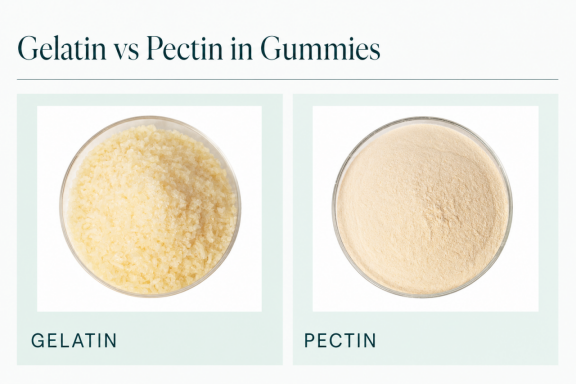
Gelatin is a protein derived from animal collagen — most often bovine hide or porcine skin, and sometimes fish. Pectin is a polysaccharide (a soluble fiber) extracted from citrus peel or apple pomace. That single difference in origin carries through to everything else: dietary positioning, labeling language, process temperature, and even the certifications you can claim. A brand targeting vegan consumers cannot use gelatin at all, and a brand targeting halal or kosher consumers must source certified gelatin — porcine gelatin is not an option. A brand prioritizing a familiar, elastic chew and collagen synergy will lean gelatin. The origin is the first filter; the performance is the second.
| Attribute | Gelatin | Pectin |
|---|---|---|
| Source | Animal collagen (bovine/porcine/marine) | Plant fiber (citrus/apple) |
| Dietary fit | Not vegan; halal/kosher available | Vegan and broadly inclusive |
| Texture | Elastic, chewy, melts cleanly | Shorter, softer, more brittle |
| Setting | Sets on cooling; thermo-reversible | Sets on cooling with acid and sugar; thermally irreversible |
| Process | Standard molding; less pH-sensitive | Tighter cook and pH control |
| Collagen synergy | Derived from collagen; naturally compatible | Possible but needs care |
Texture and Mouthfeel: What the Consumer Actually Feels
Texture is the silent hero of repeat purchase. Gelatin gummies deliver the springy, clean-melting chew that defined the category and that most consumers recognize as "a gummy." Pectin gummies are softer and shorter — they break more easily and lack that elastic pull. Neither is objectively superior; they are different experiences mapped to different brands. A premium collagen gummy built on gelatin feels indulgent and familiar. A vegan vitamin gummy built on pectin feels light and clean. The mistake is assuming one texture fits every brand — it does not, and forcing pectin into a format consumers expect to be chewy invites disappointment.
Clean-Label and Positioning Power
Pectin's biggest advantage is the word "plant-based." In a market where shoppers scan for vegan, non-GMO, and simple ingredients, pectin lets a brand say things that gelatin cannot. Gelatin counters with its own story: it is a protein ingredient, well characterized by regulators, and pairs naturally with collagen claims. For a B2B buyer, the question is which story your channel rewards. Premium beauty and joint supplements often win with the coherence of a gelatin-plus-collagen story. Mass-market wellness and vegan lines win with pectin. Match the base to the narrative your buyer already believes.
Manufacturing Implications Buyers Must Weigh
The two bases do not behave the same way on the same line. Gelatin sets by cooling, which is forgiving and fits standard starch or silicone molding. Pectin requires a controlled cook with acid and sugar to form the gel, which means tighter temperature and pH management and less room for error. If your contract manufacturer is built around gelatin, a pectin switch may mean new process validation, different cleaning and changeover procedures, and a learning curve that shows up as scrap. Buyers should ask a prospective partner which base they have actually run at scale, because "we can do both" and "we have run both in volume" are very different answers.
Stability and Shelf Life
Both bases can deliver a stable product, but the failure modes differ. Gelatin gummies can weep syrup or go sticky if moisture and storage are not controlled. Pectin gummies can lose texture or undergo syneresis if the gel network is under-built. Neither is inherently longer-lasting; the deciding factor is formula balance and packaging, not the base alone. Buyers should request stability data for the actual formula, not generic claims about the ingredient. A pectin gummy made to a poorly balanced formula fails just as fast as a gelatin one.
Cost and Margin Realities
On a per-kilo basis, gelatin is generally more cost-effective and more abundant, while pectin carries a premium tied to citrus supply and extraction complexity. But raw cost is only part of the margin story. Pectin's vegan positioning often supports a higher retail price, which can more than offset the ingredient premium. Gelatin's lower cost and easier processing protect margin on value lines. The smart buyer models the full economics — landed ingredient cost, process scrap, validation, and achievable retail price — rather than comparing sticker prices in a supplier catalog.
A Decision Framework
Rather than asking which is “better,” ask which fits your brand goal. Use the simple mapping below to turn a vague preference into a specification you can hand your manufacturer.
| If your goal is… | Choose | Why |
|---|---|---|
| Vegan / plant-based claim | Pectin | Animal-free origin supports the label |
| Collagen synergy & familiar chew | Gelatin | Derived from collagen; elastic texture |
| Lowest ingredient + process cost | Gelatin | Abundant raw material; forgiving process |
| Premium clean-label positioning | Pectin | Plant-based story supports a higher price |
| Fastest path on a gelatin line | Gelatin | Typically no new process validation |
Frequently Asked Questions
Q: Can I switch from gelatin to pectin later?
A: Yes, but treat it as a reformulation, not a swap. Expect new process validation, revised specs, and likely a texture change that consumers will notice.
Q: Which is better for a collagen gummy?
A: Gelatin is the natural fit because it is derived from the same collagen source and gives the expected chew, though pectin can work with careful formulation.
Q: Does pectin cost more?
A: Usually yes per kilo, but its vegan positioning often commands a higher retail price that recovers the premium.
Q: Which has a longer shelf life?
A: Neither by default — shelf life depends on the full formula and packaging. Require stability data on your actual product.
Key Takeaways
- Gelatin vs pectin is a brand decision first and a technical decision second — origin shapes positioning, texture, and channel fit.
- Gelatin gives elastic, familiar chew and collagen synergy; pectin gives a vegan, plant-based story with a softer texture.
- Pectin needs tighter cooking and pH control, and on a gelatin-based line it may also require new process validation.
- Model the full economics — landed ingredient cost, process scrap, validation, and achievable retail price — not just per-kilo ingredient price.
- Hand your manufacturer a base decision tied to your positioning, not a vague preference, to avoid costly rework.
References & Further Reading
- GMIA — Standard Methods for Edible GelatinGelatin Manufacturers Institute of America. Standardised Bloom, viscosity, moisture, and microbial test methods on Certificates of Analysis.
- USP–NF Reference StandardsU.S. Pharmacopeia. Compendial monograph and documentary standards for gelatin identity, strength, quality, and purity.
- FDA — Gelatin as a GRAS Food Substance (21 CFR 184.1976)U.S. FDA. Affirms gelatin is generally recognised as safe for use in food at GMP levels.
- FDA — Pectins as a GRAS Food Substance (21 CFR 184.1588)U.S. FDA. Affirms pectins are generally recognised as safe as stabilisers and thickeners in food.
- EFSA — Food AdditivesEuropean Food Safety Authority. Independent EU safety evaluation of food additives, gelling agents, and stabilisers.
- FSSC 22000 Food Safety CertificationGlobally recognised food-safety management system scheme for food manufacturers.

Post time: Oct-10-2026

