


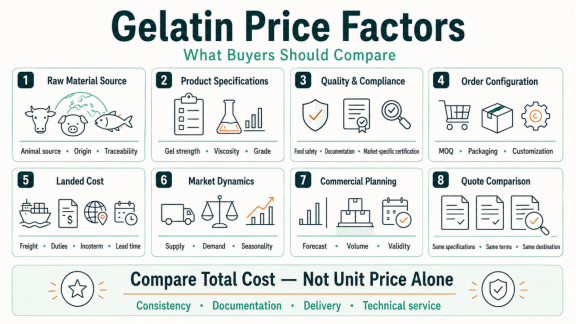
Gelatin quotations can vary even when two products appear similar on paper. Comparing price per kilogram alone may overlook differences in raw-material source, gel strength, viscosity, quality requirements, certification, packaging, and delivery terms. This guide explains the main factors that influence gelatin pricing so buyers can compare quotations on a consistent basis and make better sourcing and budgeting decisions.
Raw Material Source and Grade
Gelatin is produced from collagen-rich raw materials such as bovine hides, porcine skins, bones, and fish materials. Raw-material availability, animal source, geographic origin, traceability requirements, and local supply conditions can all influence sourcing cost. Different sources also require different preparation and processing routes. However, a lower gelatin quotation should not automatically be interpreted as lower raw-material quality; buyers should compare the declared source, specification, traceability, and finished-product performance.
Gel Strength and Quality Requirements
Pricing may vary with the target gel strength because production yield, fraction selection, blending, availability, and demand can differ between grades. Pharmaceutical gelatin may also carry additional cost because it must meet applicable pharmacopoeial, quality-control, testing, documentation, and traceability requirements.
Certification and Compliance Requirements
Every certification carries real cost: segregated lines, audited documentation, and sometimes dedicated raw-material streams. HALAL and Kosher gelatin, for example, require supervised handling and can limit which raw materials you can use. For markets in the Middle East, Southeast Asia, or Jewish communities, that premium is often non-negotiable — and it is reflected in the quote.
Country of Origin and Logistics
The final landed cost depends on more than the ex-works price. Freight, inland transport, insurance, import duties or taxes, port charges, shipment size, and Incoterms can all change the amount a buyer ultimately pays. Factory-direct sourcing may simplify the supply chain. Buyers should compare quotations using the same Incoterm and destination basis and include lead time in their inventory planning.
MOQ, Packaging and Customization
Small orders and custom blends carry fixed costs that get spread over fewer kilograms, raising the effective unit price. Standard 25 kg bags in full containers are the cheapest configuration; retail packs, custom mesh sizes, or tailored gel strength/viscosity profiles add cost. Even the choice between a 25 kg bag and a 1-ton bulk sack changes handling and per-kg price, so always specify packaging when you request a quote. This is why understanding gelatin MOQs matters alongside price.
Market and Seasonal Dynamics
Because raw material is tied to meat production, gelatin pricing reacts to livestock disease outbreaks, feed costs, and seasonal slaughter volumes. Demand spikes from the confectionery, pharmaceutical, and supplement sectors also tighten supply. Buyers who lock annual framework agreements or forward contracts smooth out these swings better than spot purchasers, and they protect lead time when competitors are scrambling for material.
When a Higher Unit Price Can Still Offer Better Value
The lowest unit price is not always the lowest total cost. Differences in gel strength, viscosity, batch consistency, documentation, lead time, or application performance may create additional qualification, adjustment, inventory, or rework costs. A higher unit price can therefore offer better overall value when it is supported by consistent specifications, reliable documentation, delivery performance, and technical service. Buyers should compare these factors using qualification data rather than price or supplier claims alone.
Negotiating and Locking Price
Effective price negotiation starts with a clear specification and purchasing forecast. Provide expected volume, packaging, delivery schedule, destination, and required quotation validity so suppliers can quote on the same basis. Framework or call-off arrangements may support more predictable purchasing, but price, release quantity, lead time, and validity must be agreed explicitly. When comparing suppliers, use an equivalent grade, gel strength, viscosity, certification, packaging, and Incoterm so the quotations represent the same requirement.
Reading a Gelatin Quote Like a Pro
A useful gelatin quotation should identify the grade, animal source where relevant, gel strength or Bloom value, viscosity, packaging, certification requirements, Incoterm, destination, lead time, and quotation validity—not only the price per kilogram. Before comparing suppliers, normalize these conditions and confirm that the specifications and commercial terms are equivalent. Missing information should be clarified before a price difference is treated as a real saving.
Frequently Asked Questions
What Is a Typical Gelatin Price Range?
Pricing depends on animal source, gel strength, viscosity, quality or pharmacopoeial requirements, certification, packaging, order quantity, Incoterm, and destination. Rather than comparing a generic market number, ask suppliers to quote against the same specification and commercial terms.
Why Is Pharmaceutical Gelatin More Expensive?
Pharmaceutical gelatin may carry a higher price because it must meet the applicable pharmacopoeial and customer requirements for identity, physical and chemical quality, microbiological quality, documentation, and traceability. Additional testing, quality-system controls, and regulatory documentation can increase the cost of supplying the grade. However, the exact price difference depends on the specification, manufacturer, certification, and market rather than on a fixed pharmaceutical premium.
Conclusion
Gelatin price per kg reflects a combination of raw-material source, gel strength, quality requirements, certification, packaging, order quantity, logistics, and market conditions. Buyers should therefore compare total landed cost and qualified product performance rather than the headline price alone. For an edible or pharmaceutical gelatin quotation, provide Gelken with your application, required gel strength and viscosity, animal source, certification, quantity, packaging, and destination. For more sourcing guidance, explore our guides to gelatin MOQs and supplier selection.

Post time: Aug-12-2026

