


A practical comparison of dosing, hydration, handling, and production suitability
Gelatin is commonly supplied as powder or granules, as well as in sheet form (also known as leaf gelatin). Although these forms are based on the same gelatin material, their particle or sheet structure affects weighing, hydration, handling, and suitability for different production systems. This guide compares powdered or granular gelatin with gelatin sheets so manufacturers can select the format that best fits their batch size, equipment, and workflow.
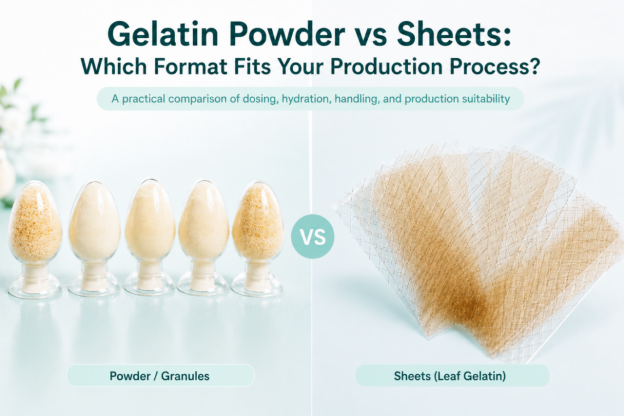
What Is Gelatin Powder?
Powdered and granular gelatin are produced by drying gelatin and reducing it to a defined particle-size range. These are widely used formats in industrial food, pharmaceutical, and nutraceutical manufacturing because they can be weighed and handled efficiently at scale. Grades are available with different gel strengths, viscosities, particle sizes, animal sources, and quality requirements.
What Are Gelatin Sheets?
Gelatin sheets, or leaf gelatin, are thin dried sheets produced to a defined weight and gel strength. Because each product is supplied at a consistent weight per sheet, counting can simplify dosing in pastry production, professional kitchens, and other small- or controlled-batch processes.
Comparison at a Glance
| Factor | Powder | Sheets |
|---|---|---|
| Dosing | By weight; suited to manual or automated weighing | By weight or sheet count when sheet specification is fixed |
| Hydration | Fast; disperses in warm water | Normally soaked in cold water, drained, then dissolved in warm formulation |
| Automation | Better suited to automated weighing and bulk handling | Usually better suited to manual or semi-manual dosing |
| Packaging | Bulk bags, totes | Cardboard boxes, individual wrapping |
| Typical fit | Large-scale and automated industrial production | Pastry, foodservice, specialty foods and controlled small batches |
When to Choose Powder
- You run continuous or batch production at scale.
- You need a defined gel strength, viscosity, and particle-size specification.
- Efficient bulk handling, storage, and transport are priorities.
When to Choose Sheets
- You work with small or controlled batches where sheet counting simplifies dosing.
- Your team is trained in bloom-and-squeeze pastry workflows.
- You want a format with no dust and minimal airborne particles.
Conversion tip: do not substitute gelatin sheets and powder by sheet count or weight alone unless their gel strength is equivalent. Check both the weight per sheet and Bloom value, then adjust the powder quantity if the two products have different gel strengths. A small formulation trial is recommended before changing formats.
Key Takeaways
Powdered or granular gelatin is generally better suited to industrial-scale production because it integrates more easily with weighing, batching, and automated handling systems. Gelatin sheets offer convenient portion control and manual handling for pastry, foodservice, specialty foods, and smaller controlled batches. Both formats require appropriate hydration and dissolution procedures, so the best choice depends on batch size, equipment, workflow, and the required gelatin specification.
About the author

Post time: Aug-28-2026

