


Gelatin MOQ Explained: Minimum Order Quantities for Purchaser
When you request a gelatin quotation, the supplier will normally confirm a minimum order quantity (MOQ). For first-time purchaser, this figure may appear arbitrary, but it usually reflects order handling, packaging, quality documentation, inventory allocation, and logistics. Understanding what an MOQ covers helps buyers compare quotations accurately and balance unit cost, cash flow, and inventory risk.
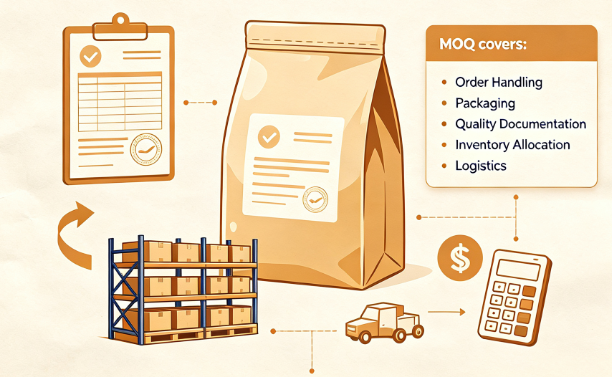
What Is an MOQ, Really?
An MOQ is the smallest commercial quantity a supplier will accept for one order of a defined gelatin grade or specification. It is different from a volume discount, available stock, or packaging unit. The minimum may apply per grade, animal source, specification, packaging format, or shipment arrangement. Certification requirements may also affect availability, but buyers should confirm whether the MOQ applies to the entire order or separately to each item.Why Gelatin Suppliers Set MOQs
- Production and blending: standard gelatin grades are produced and blended in commercial lots, while custom Bloom, viscosity, or source requirements may need separate planning.
- Packaging and handling: each order requires bagging, palletising, lot allocation, labels, and export documents.
- Quality documentation: released lots require traceable batch records and a Certificate of Analysis, regardless of the quantity purchased.
- Inventory management: reserving a small quantity of a specific lot can create fragmented stock that is harder to manage.
- Shipping efficiency: pallet, LCL, and full-container shipments have different handling and freight costs per kilogram.
Factors That Raise or Lower Your MOQ
- Grade and certification: standard stock grades are easier to allocate than custom Bloom, viscosity, particle size, or animal-source requirements.
- Packaging format: bulk 25 kg bags consolidate better than small retail packs.
- Certification and documents: valid Halal, Kosher, pharmaceutical, or destination-market documents must match the ordered material; special documentation may require separate confirmation.
- Relationship and forecast: a credible annual forecast may support scheduled deliveries, but the commercial MOQ and release terms must be agreed in advance.
Working MOQ Into Your Planning
Rather than treating MOQ as a hurdle, build it into your demand planning. Estimate your annual consumption, then decide whether one large order (lowest unit cost, higher inventory carry) or several smaller releases (more flexibility, slightly higher unit cost) fits your cash flow and warehouse capacity. Many buyers split the difference with a quarterly cadence that keeps working capital reasonable while still clearing the supplier's volume threshold. If storage is tight, ask whether the supplier can hold finished goods and release against call-off — turning their MOQ into your just-in-time supply and freeing up warehouse space.How to Negotiate a Lower MOQ
- Request a trial or sample order before committing to commercial volume.
- Ask whether a standard in-stock grade or paid pilot quantity is available for a larger evaluation.
- Consider combining compatible grades in one shipment, while confirming whether the MOQ still applies per grade.
- Provide a realistic annual forecast and discuss scheduled deliveries against a confirmed volume commitment.
- Avoid unnecessary custom packaging or specifications during the first order.
MOQ for Startups vs Established Buyers
Startups and first-time buyers should separate sample evaluation from commercial ordering. A small laboratory sample can confirm basic identity and formulation suitability, but it may not be sufficient for a full production-line trial. If a larger pilot quantity is needed, availability, price, and documentation should be negotiated separately. Established buyers may have more flexibility when they can provide reliable forecasts, repeat orders, and agreed annual volumes. In both cases, MOQ is a commercial term to clarify, not a measure of product quality.MOQ vs the True Unit Cost
The lowest MOQ is not automatically the lowest-cost option, and the largest order is not always the most economical. Compare total landed cost, freight, import charges, inventory carrying cost, shelf life, documentation, lead time, batch consistency, and the risk of production interruption. A smaller order may reduce cash and inventory exposure, while a larger order may lower unit and freight costs. The best choice is the quantity that supports both production continuity and responsible inventory control.Frequently Asked Questions
Can I order less than the stated MOQ?
Possibly, but it depends on the grade, available stock, sample policy, and intended evaluation. A supplier may offer a free sample, a paid trial quantity, or another arrangement, but this should not be assumed. Sub-MOQ commercial quantities may carry a higher price per kilogram because handling, packaging, and documentation costs are spread over less material.Do MOQs apply to samples?
No — reputable suppliers run a separate sample program (typically 5–25 kg) specifically so buyers can qualify the material on their line before placing a full production order. Treat the sample as the real qualification step, not a formality.Conclusion
A gelatin MOQ reflects how the material is produced, packaged, and shipped rather than serving as a barrier for smaller buyers. If you are planning your first order, request a quotation and ask about available gelatin grades, sample options, and order arrangements. For a broader understanding of gelatin purchasing, explore our guides to gelatin price factors and choosing a gelatin supplier.
Post time: Aug-05-2026

