


When you need to set a dessert, gummy, or dairy product, two names come up most often: edible gelatin and agar agar. Both form gels, but they are fundamentally different ingredients — and the "right" choice depends on your product, your process, and your consumers. Formulators sometimes assume they are interchangeable "gelling powders," only to discover that swapping one for the other changes texture, melting behavior, and even whether the product survives shipping. This comparison breaks down exactly how they differ so you can choose with confidence and avoid costly reformulation later.
What Is Agar Agar?
Agar agar (often just "agar") is a plant-based hydrocolloid extracted from red seaweed (Rhodophyta). It is the structural polysaccharide in the algae's cell wall, refined into powder, flakes, or bars. Because it comes from seaweed, agar is naturally vegan, vegetarian, and halal/kosher by default — a major advantage for plant-based product lines.
Chemically, agar is a complex of agarose and agaropectin. It sets into a firm, brittle gel at very low concentrations (typically 0.5–1.0 %) and, crucially, melts at 80–90 °C — far above body temperature. That is why agar-set products hold their shape at room temperature and never "melt in the mouth" (Pang et al., 2020).
Commercial agar is sold as powder, flakes, or bars, and it requires boiling (95–100 °C) to fully dissolve before it can set on cooling — unlike gelatin, which hydrates and dissolves in warm water. Because seaweed harvests vary by season and region, agar price and supply can be more volatile than gelatin's livestock-by-product streams, an important consideration for high-volume buyers.
What Is Edible Gelatin? (Quick Recap)
Edible gelatin is a protein derived from the partial hydrolysis of animal collagen (bovine hides, porcine skins, or bones). It forms thermo-reversible gels that melt near body temperature (~35 °C), giving foods a smooth, "melt-in-the-mouth" texture that consumers associate with premium gummies, marshmallows, and panna cotta. It typically sets at 2–10 % concentration depending on bloom strength (GROW, n.d.).
Gelatin comes in two main types: Type A (acid-processed) with a higher isoelectric point (~7–9), and Type B (alkali-processed) with a lower isoelectric point (~4.7–5.4). That difference affects how the gelatin interacts with your formulation's pH — relevant when you pair it with acidic fruit systems or dairy. Gel strength (80–320) then governs gel firmness. For a deeper dive, see our guide on understanding gel strength.
Side-by-Side Comparison
| Factor | Edible Gelatin | Agar Agar |
| Source | Animal collagen (bovine/porcine) | Red seaweed (plant-based) |
| Dietary fit | Not vegetarian/vegan | Vegan, vegetarian, halal, kosher |
| Gelling temperature | Sets at ~20–25 °C | Sets at ~32–40 °C |
| Melting temperature | ~35 °C (melts in mouth) | 80–90 °C (heat-stable) |
| Texture | Elastic, smooth, brittle-free | Firm, brittle, short (snaps) |
| Typical use level | 2–10 % (by bloom) | 0.5–1.0 % |
| Clarity | Clear to amber, depends on grade | Very clear, glossy |
| Flavor | Neutral (some grades faint) | Neutral (can be seaweed-noted) |
| Best at room temp? | Can soften/melt; needs cool storage | Holds firm without refrigeration |
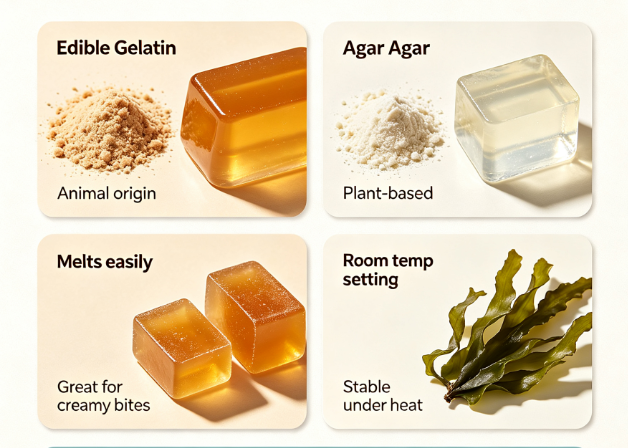
Key difference: Gelatin melts at body temperature and gives an elastic, melt-in-mouth bite. Agar is heat-stable and gives a firm, brittle set. They are not interchangeable gram-for-gram — switching one for the other changes both your recipe and your consumer experience.
Cost, Availability & Sourcing
On a per-kilogram basis, agar is generally more expensive than gelatin, but its much lower use level (roughly one-fifth to one-tenth the dosage) can narrow the gap in the finished product. Gelatin benefits from steady supply tied to the meat industry's by-product streams, while agar supply tracks seaweed harvests and can tighten during poor seasons or export restrictions. For global buyers, gelatin also offers more flexible certification paths — including porcine-free bovine gelatin, fish gelatin, and HALAL/Kosher grades — whereas agar's plant origin automatically satisfies most religious and vegan claims. On storage, both are shelf-stable dry powders, but gelatin is more sensitive to high humidity (it can clump and pre-gel), so climate-controlled warehousing matters more for gelatin than for agar.
Application Quick-Reference
| Product Type | Best Choice | Why |
| Gummy candy / jelly sweets | Gelatin | Elastic chew and melt-in-mouth bite consumers expect |
| Marshmallows, mousses | Gelatin | Foaming and emulsifying power agar lacks |
| Panna cotta, custards | Gelatin | Smooth, creamy set without brittleness |
| Ambient fruit jelly / bakery filling | Agar | Holds firm at room temperature, no refrigeration |
| Vegan/plant-based desserts | Agar | Non-animal, meets vegan labeling |
| Canned or retorted products | Agar | Survives high heat processing |
Frequently Asked: Can I Just Substitute One for the Other?
Not directly. Because agar gels at roughly one-tenth the dosage and does not melt in the mouth, replacing gelatin 1:1 would produce a rock-hard, brittle product; replacing agar with gelatin would leave an ambient product that slumps and weeps. If you must switch (for example, to make a vegan version of a gelatin recipe), rebalance the use level, adjust setting and storage temperatures, and re-test texture and shelf life. Treat it as a reformulation, not a substitution.
Which One Should You Choose?
Choose Edible Gelatin When…
- · You want the signature chewy, elastic texture of gummies, marshmallows, or jelly candies.
- · Your product is a dairy dessert (panna cotta, mousse, yogurt) where a smooth mouthfeel matters.
- · You need foaming or emulsifying behavior (marshmallow whip, clarified beverages).
- · Your product is refrigerated or temperature-controlled and won't sit in a hot warehouse.
- · You require specific bloom/viscosity control for a precise production line.
- · Your brand is vegan, vegetarian, or plant-based and must avoid animal ingredients.
- · The product must hold shape at room temperature (bakery fillings, ambient confectionery, canned goods).
- · You want a firm, clean, brittle set (fruit jellies, aspics, molecular-gastronomy spheres).
- · You need a very low use level and a glossy, transparent finish.
Choose Agar Agar When…
Can They Work Together?
Yes. In some formulations, gelatin and agar are blended to combine gelatin's elasticity with agar's heat stability — for example, a filling that needs to survive shipping yet deliver a soft bite. This requires careful ratio and process tuning; our application team can help you prototype such combinations with Gelken gelatin grades. A common hybrid approach uses a small agar addition to a gelatin base purely as an insurance against summer softening, while keeping the dominant melt-in-mouth character gelatin provides.
Conclusion
The edible gelatin vs agar agar decision is not about which is "better" — it is about fit. Gelatin wins on texture, elasticity, and mouthfeel for refrigerated, animal-derived products; agar wins on plant-based positioning and heat-stable firm sets. Match the gelling agent to your consumer promise, your process, and your storage chain.
If your product calls for the elastic, melt-in-mouth quality only gelatin delivers, explore Gelken's edible gelatin range (80–320 Bloom, customizable) and request a sample for bench testing. And if you are still mapping out specifications, our guides on gel strength and how gelatin is made will help you brief your R&D team with precision.
About the Author
Eric Ma — General Manager
Leveraging two decades of expertise in the gelatin and collagen manufacturing sector, Eric has directed strategic operations that consistently deliver robust business growth and global market expansion.
Contact with Eric
Post time: Jul-21-2026

