


Collagen peptides, also known as hydrolyzed collagen or collagen hydrolysate, are widely used as protein ingredients in dietary supplements and functional foods. Unlike gelatin, which is valued for its gelling and film-forming properties, collagen peptides are hydrolyzed into smaller peptide chains and are primarily selected for their nutritional value, water solubility, and formulation flexibility.
For product developers and ingredient buyers, however, selecting collagen peptides involves more than choosing an animal source or checking protein content. Molecular-weight distribution, solubility, particle size, bulk density, sensory characteristics, moisture, and compatibility with other ingredients can all influence processing and finished-product performance.
This guide focuses on the most practical nutraceutical applications for collagen peptides and the specifications that matter when evaluating a suitable grade.
What Are Collagen Peptides?
Collagen peptides are produced by hydrolyzing collagen-rich animal materials into smaller peptide chains. Depending on the product, collagen may originate from bovine hides, fish skin or scales, porcine materials, poultry cartilage, or other approved animal sources.
The degree of hydrolysis is one of the major differences between collagen peptides and gelatin. Gelatin retains protein chains long enough to form a thermoreversible gel under suitable conditions. Collagen peptides are hydrolyzed further, resulting in lower molecular weight, greater water solubility, and little or no characteristic gelatin-gelling ability.
This distinction is particularly important in formulation. Adding collagen peptides to a gummy, for example, increases its collagen protein content but does not replace the gelatin, pectin, or other hydrocolloid responsible for building the gummy structure.
Why Collagen Peptide Properties Matter in Formulation
Collagen peptide grades can differ in manufacturing and application performance even when their basic specifications appear similar. Solubility and dispersibility affect water-based formulations, while particle size and bulk density influence dry blending, dosing, packaging, and capsule filling.
Moisture and powder characteristics can affect flowability and caking. Taste, odor, and color also become increasingly important as the collagen dosage rises, especially in beverages, powders, and foods where the ingredient forms a substantial part of the formulation.
For this reason, formulators should evaluate collagen peptides in the intended product system rather than selecting a grade solely from a generic specification sheet.
Common Applications of Collagen Peptides
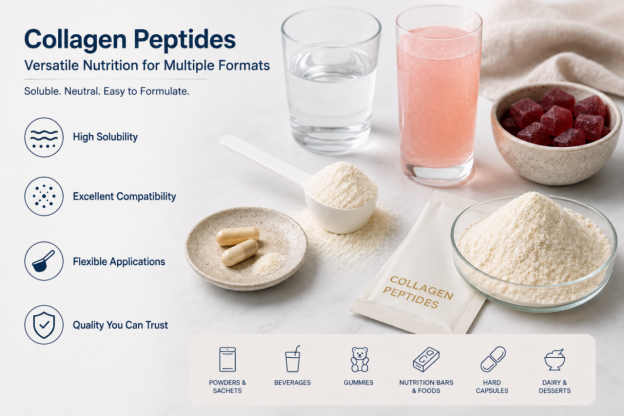
| Application | Application | Key Formulation Considerations |
|---|---|---|
| Powders & sachets | Supports gram-level servings and flexible dry blends | Flowability, particle size, bulk density, caking |
| Beverages | Water-soluble grades are easy to incorporate into drink systems | Solubility, pH, flavor, clarity, heat stability |
| Gummies | Adds collagen protein without being the primary gelling agent | Gel system, solids, flavor, texture, dosage |
| Nutrition bars & functional foods | Provides protein enrichment in solid food formats | Texture, moisture, flavor, ingredient interaction |
| Hard capsules | Suitable for lower doses or combination formulations | Bulk density, flow, capsule capacity, dose |
| Dairy & dessert systems | Can add collagen protein to existing food matrices | Viscosity, texture, sensory profile, stability |
Powder Blends and Sachets
Powders and sachets are among the most practical formats for collagen peptides because they can accommodate gram-level serving sizes without the volume limitations of tablets or capsules. They also allow collagen to be combined with vitamins, minerals, flavors, sweeteners, and other nutritional ingredients.
Important manufacturing considerations include powder flow, bulk density, particle-size distribution, dispersibility, flavor distribution, and resistance to caking. If the different powders in a blend vary greatly in size or density, segregation during mixing, transport, or packaging may affect serving uniformity.
For instant-drink powders, dispersibility and dissolution under the intended preparation conditions should also be evaluated.
Beverages and Liquid Systems
Water-soluble collagen peptides are widely suited to powdered drink mixes and, depending on the grade and formulation, selected ready-to-drink products. Their use in liquid systems requires more than simply confirming that the raw material dissolves in water.
Formulators should consider collagen concentration, pH, acids, minerals, sweeteners, flavors, heat treatment, clarity requirements, and storage stability. Increasing collagen concentration may influence viscosity, taste, color, mouthfeel, or sedimentation.
A grade that performs well in a lightly fortified drink may therefore behave differently in a high-protein collagen beverage. Testing should be carried out in the complete beverage formulation.
Gummies and Functional Foods
Collagen peptides can be incorporated into gummies, nutrition bars, dairy products, desserts, snacks, and other functional foods as a protein ingredient.
In gummies, however, collagen peptides should not be confused with gelatin. The peptides contribute collagen protein but do not normally provide the primary gel structure. Gelatin, pectin, or another suitable gelling system is still required to create the intended gummy texture.
At higher inclusion levels, collagen peptides may also affect solids, sweetness perception, texture, color, and flavor. Their impact should therefore be evaluated as part of the complete recipe rather than treated as a nutritionally active but formulation-neutral addition.
Collagen Peptides in Hard Capsules
Hard capsules can contain collagen peptides when the intended dose and powder properties make the format practical. The powder may be filled alone or combined with vitamins, minerals, botanical extracts, or other ingredients.
Particle size, bulk density, moisture, and flowability are important because they influence dosing and capsule-filling consistency. Grades with poor flow may require formulation or processing adjustments before high-speed filling.
The main limitation is capsule capacity. Collagen products frequently use relatively high daily servings, so powders, sachets, or beverages may be more practical when several grams of collagen are required.
Collagen peptides themselves should not be used as a substitute for gelatin in conventional capsule shells. Their shorter peptide chains do not provide the gel and film structure required for standard gelatin capsule manufacturing.
Stability and Handling Considerations
Collagen peptide powders should be stored and handled according to the specification of the individual grade rather than a universal moisture or temperature rule.
Humidity may influence caking and powder flow, while formulation pH, heat treatment, other ingredients, and packaging can affect sensory and physical stability. Changes in collagen source, molecular-weight profile, or processing method may also change product behaviour.
For commercial development, stability should therefore be confirmed in the final formulation and final packaging rather than inferred from the raw-material specification alone.
Regulatory and Labeling Considerations
The regulatory classification and permitted ingredient terminology for collagen peptides vary by destination market and intended use.
Manufacturers should confirm animal source, ingredient declaration, import requirements, traceability documents, and any required Halal, Kosher, or other certifications. Marketing claims should also be evaluated separately from the technical suitability of the raw material.
A collagen peptide that is technically suitable for a formulation is not automatically approved for every claim or labeling approach in every market.
Frequently Asked Questions
Q: Are collagen peptides the same as gelatin?
A: No. Both originate from collagen, but their degree of hydrolysis and functional properties differ. Gelatin retains the ability to form a thermoreversible gel, while collagen peptides are hydrolyzed further and generally remain soluble without forming the characteristic gelatin gel.
Q: Which formats are most practical for collagen peptides?
A: Powders, sachets, and beverage systems are particularly practical because they can accommodate relatively high collagen quantities. Gummies, functional foods, and capsules are also possible, but dosage, formulation, and processing requirements should be evaluated separately.
Q:Can collagen peptides replace gelatin in gummies?
A: Not as a direct gelling replacement. Collagen peptides contribute collagen protein but generally do not provide the gel structure required for a conventional gummy. Gelatin, pectin, or another suitable gelling system is normally needed.
Q: What should buyers check when sourcing collagen peptides?
A: Start with animal source, protein content, molecular-weight range, solubility, particle size, sensory characteristics, moisture, microbiological quality, certification, and supporting documentation. Then add application-specific requirements and test a representative sample in the intended formulation.
Key Takeaways
Collagen peptides are primarily nutritional protein ingredients. Their solubility, powder characteristics, sensory profile, molecular-weight distribution, and source can nevertheless have an important influence on formulation and processing.
Collagen peptides are primarily nutritional protein ingredients rather than universal multifunctional excipients. Their solubility, powder characteristics, sensory profile, molecular-weight distribution, and source can nevertheless have an important influence on formulation and processing.
If you are evaluating collagen peptides for a new product, provide Gelken with your intended application, required animal source, protein and molecular-weight requirements, solubility needs, quantity, certification requirements, and destination market. Gelken can provide a suitable specification and representative sample for formulation evaluation.

Post time: Aug-20-2026

