


How to build a collagen jelly or functional jello that sets cleanly, carries a real dose, and survives the shelf — a practical guide for brands and manufacturers entering the functional gel category.
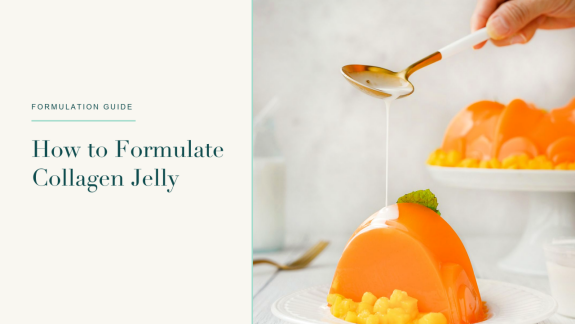
The Rise of Functional Jelly
Jelly is one of the oldest confectionery formats, but it is being reborn as a functional delivery system — a soft, portion-controlled gel that carries collagen, vitamins, or other actives in a format consumers find easy and pleasant to eat. For B2B buyers, functional jelly is attractive because it sidesteps the pill fatigue of tablets and the mess of powders, and it lends itself to single-serve, on-the-go positioning. But turning a dessert jelly into a credible functional product is a formulation discipline. The gel must set reliably, hold an active dose, survive storage, and still taste like something people want to finish. The manufacturers who do this well are building a genuine moat.
Why Gelatin Is the Natural Base
Gelatin is the obvious gelling agent for a collagen jelly because it is the same protein family as the active you are adding, it sets cleanly at low use levels, and it gives the tender, melt-in-mouth texture consumers associate with premium jelly. Its thermo-reversible set also means the product can be deposited warm and set by cooling, which is gentle on heat-sensitive actives. Pectin and other hydrocolloids can also build a gel, but gelatin’s synergy with collagen and its forgiving process make it the default for functional jello aimed at a wellness positioning. Choosing the base is therefore less about novelty and more about coherence with your active and your claim.
| Consideration | Gelatin jelly | What it means for buyers |
|---|---|---|
| Texture | Tender, melts in mouth | Premium, pleasant eating experience |
| Collagen fit | Same protein family, natural | Coherent collagen + jelly story |
| Process | Warm deposit, cool set | Gentle on heat-sensitive actives |
| Dose handling | Stable at low solids | Room for meaningful active load |
Getting the Set Right
A functional jelly lives or dies on its set. Too little gelling agent and the product is a puddle that cannot hold shape or dose; too much and it turns rubbery and unpleasant. The levers are gelatin concentration, Bloom strength, total solids, and setting temperature. Higher Bloom gelatin lets you use less powder for the same firmness, which leaves more room in the formula for actives and flavor. The target texture should be firm enough to demold and package, yet tender enough to eat comfortably. Buyers should ask for the exact gelatin percentage and Bloom grade in the reference formula, because those two numbers define the entire eating experience.
Adding Collagen Peptides to the Gel
Adding collagen peptides to a jelly is more forgiving than in a gummy or foam, but it still demands intent. The peptides are water-soluble and disperse readily, but they add protein load and a small water demand that must be balanced against the gel strength. The practical method is to hydrate the gelatin, prepare the syrup and active dispersion, combine at a controlled temperature, then add acid and flavor last to protect both the gel and the peptide. Because jelly is deposited warm, keep peptide exposure to heat brief. A manufacturer with functional jelly experience will hand you a starting ratio that already survives stability, which is the difference between a three-month launch and a six-month struggle.
Balance total solids when you add peptides — they increase water demand. Under-build the gel and your jelly weeps; over-build it and it eats like rubber. Get the ratio from someone who has run it.
Building in Functionality Beyond Collagen
Many functional jellies stack multiple actives: collagen plus vitamin C, biotin, or even probiotics for a wellness bundle. Each addition changes the physical and chemical balance. Vitamin C is acid-stable but affects flavor and pH; probiotics demand protection from heat and moisture; minerals can cloud or alter texture. The formulation must account for interactions, not just dump actives into a base recipe. For a B2B buyer, this is where a manufacturer’s applications lab earns its fee: they manage the interactions so your finished jelly is stable, clear, and palatable rather than a cloudy, off-tasting science experiment.
Sugar-Free and Better-for-You Versions
Sugar does more than sweeten in a jelly — it contributes to body, preservation, and the eating texture. Moving to a sugar-free or reduced-sugar formula changes the water activity and can soften the set, so a bulk sweetener or a small hydrocolloid assist is often needed to restore structure and shelf stability. The good news is that jelly tolerates these swaps well when engineered, and a sugar-free functional jelly fits the fastest-growing wellness segments. Buyers should expect a deliberate sweetener-and-stabilizer strategy in the spec, not a simple sugar omission that quietly ruins the product.
Process and Packaging for Stability
Functional jelly is typically deposited warm into molds or direct-fill cups, set by cooling, then packed. The risks are syneresis (weeping liquid), texture change over time, and active degradation. Controlled cooling avoids stress cracks; barrier packaging and, for many actives, desiccants or modified atmosphere extend the window. Because the active is the whole point, stability data must confirm the delivered dose at end-of-shelf, not just at filling. A supplier who cannot show that data is asking you to stake your brand on hope.
What to Require From a Manufacturing Partner
- A reference functional jelly formula with documented gelatin % and Bloom grade.
- Proven handling of your specific actives, including any heat- or moisture-sensitive ones.
- Stability data tied to the delivered dose at the end of the claimed shelf life.
- Sugar-free or clean-label capability if that is your positioning.
- CoA, traceability, and market-matched certifications (halal, kosher, non-GMO as needed).
Frequently Asked Questions
Q: Can I add multiple actives to one jelly?
A: Yes, but each changes the balance. Vitamin C, minerals, and probiotics all interact, so the formula must be engineered, not just combined.
Q: Why did my jelly weep liquid?
A: Usually under-built gel or unbalanced solids. Raise gelatin or adjust total solids, and use barrier packaging to control moisture.
Q: Is gelatin or pectin better for functional jelly?
A: Gelatin is the natural fit for collagen jelly and gives a tender texture; pectin serves vegan positioning but needs a different process.
Q: How much collagen can a jelly carry?
A: Enough for a meaningful dose if total solids are balanced. Require end-of-shelf stability data to prove the claim holds.
Key Takeaways
Key Takeaways
- Functional jelly is a growing delivery format, but it is a formulation discipline, not a dessert with powder added.
- Gelatin is the natural base for collagen jelly — same protein family, gentle warm-deposit process, tender texture.
- Set depends on gelatin concentration, Bloom grade, total solids, and set temperature; ask for the exact numbers.
- Adding actives changes physical and chemical balance — engineer interactions, don’t just combine them.
- Require stability data proving the delivered dose at end-of-shelf, and engineer packaging for moisture control.
References & Further Reading
- FDA - Gelatin as a GRAS Food Substance (21 CFR 184.1976)U.S. FDA. Affirms gelatin is generally recognised as safe for use in food at GMP levels.
- FDA - Pectins as a GRAS Food Substance (21 CFR 184.1588)U.S. FDA. Affirms pectins are GRAS as stabilisers and thickeners in food.
- EFSA - Novel Foods (collagen peptides safety)European Food Safety Authority. Independent EU safety evaluation of novel foods including collagen peptides.
- FSSC 22000 - Food Safety CertificationGlobally recognised food-safety management system scheme for food manufacturers.

Post time: Oct-15-2026

