


A buyer's guide to plant-based gelling systems — what actually replaces gelatin, where each one wins, and how to brief your manufacturer.
Why Buyers Are Asking for Vegan Gelatin
Gelatin is a protein obtained by partial hydrolysis of animal collagen. Products intended to meet vegan or vegetarian requirements therefore need another approach to gelling and texture. Halal and Kosher requirements involve separate assessments of source, manufacture, and certification, and suitable certified gelatin may be available. For vegan reformulation, begin with the function gelatin performs: elastic gel formation, melting behavior, foam stabilization, or a combination. Gelatin’s thermoreversible gels contribute to a melt-in-the-mouth texture, with performance depending on grade and formulation. Alternatives can deliver appealing textures, but their setting conditions and processing requirements differ. This guide compares common options for food applications and the evidence buyers should request before selecting a system.
For products that permit animal-derived ingredients, buyers can discuss gelatin grade selection with Gelken. Compare gel strength, viscosity, source, documentation, and application performance with the requirements of the intended product.
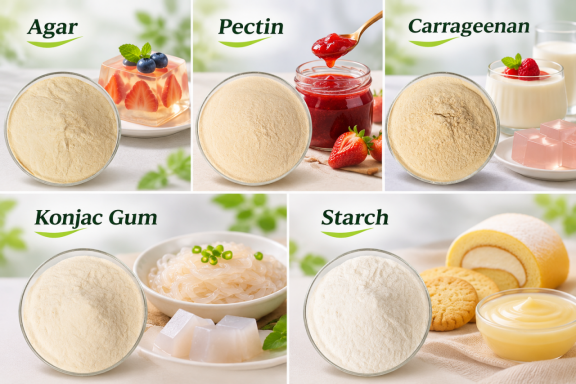
The Main Plant-Based Gelling Systems
Agar-Agar
Derived from red seaweed, agar sets firm gels at room temperature and tolerates heat far better than gelatin. That heat stability is useful for products that must survive warm supply chains, but the trade-off is a more brittle, less elastic bite and a higher melt point that does not deliver the same mouth-coating softness. Agar is excellent for firm desserts, jellies, and bakery fillings but often needs blending to approach gelatin's bounce.
Pectin
Pectin, commonly obtained from citrus peel or apple pomace, is widely used in fruit gummies, jams, and fruit preparations. High-methoxyl (HM) grades generally gel under acidic conditions with sufficient soluble solids. Low-methoxyl (LM) grades form gels through calcium interactions and can support reduced-sugar formulations. Calcium sensitivity and thermal behavior vary with grade and formulation; some amidated LM systems are thermoreversible. Select pectin according to soluble solids, pH, calcium availability, and setting speed, then verify texture and flavor release in the complete recipe.
Carrageenan
Carrageenan is also extracted from red seaweed. Kappa grades generally form firm gels, while iota grades provide softer, more elastic gels; lambda primarily thickens without gelling. Ion conditions, protein composition, and processing influence performance. Selected grades can structure puddings and dairy alternatives or stabilize beverages. Choose the type and dosage for the specific formulation, and confirm permitted uses and labeling requirements in the destination market.
Konjac, Starch, and Blends
Konjac glucomannan provides strong water binding and can modify texture in blends, including carrageenan systems. Its gel behavior depends on formulation and processing. Starches offer thickening, binding, and gelling; selected confectionery grades can produce firm gels and useful clarity. Choose by the required bite, cooking conditions, and storage behavior. Either a single hydrocolloid or a blend may suit the application, depending on the functions being replaced.
When to Use Each Alternative
| Alternative | Best-fit applications | Watch-outs vs gelatin |
|---|---|---|
| Agar | Firm desserts, jellies, bakery fillings | Brittle, high melt point, less elastic |
| Pectin | Fruit gummies, jams, fruit snacks | Needs sugar/acid/calcium; not thermo-reversible |
| Carrageenan | Plant milks, puddings, yogurt, protein drinks | Type selection critical; regulatory scrutiny |
| Konjac systems | Low-sugar gummies, fiber-fortified foods | Used with others to tune elasticity |
| Starch systems | Thickening, pie fillings, sauces | Thickens, does not firm-set like gelatin |
Formulation and Process Considerations
Develop a process for the selected system, covering dispersion, hydration, heating, addition sequence, and depositing conditions. In pectin systems, acid or calcium addition can change the available processing window. Agar needs adequate dissolution, while gelling carrageenans respond to ion conditions and cooling. Match the setting rate to transfer and filling equipment. For aerated products such as marshmallows, also evaluate foam formation and stabilization, since replacing gelatin’s gelling function addresses only part of its role. Confirm the recipe at pilot scale before commercial production.
What to Require From Your Supplier
- Ingredient composition, specification, and documented suitability for the intended vegan claim.
- Grade-specific dispersion, hydration, heating, and ingredient-addition guidance.
- Relevant stability data to guide validation in your packaging and distribution conditions.
- Source, traceability, allergen information, and destination-market compliance documents.
- Application support for target texture, flavor release, and processing compatibility.
- Representative samples and, where available, a starting formulation for pilot trials.
Select the system by the product’s dietary positioning, texture, process, and total manufacturing cost. Compare ingredient dosage, energy use, production time, and yield alongside purchase price. A vegan product may use one suitable gelling agent or a tailored blend; a product allowing animal-derived ingredients may retain gelatin where it meets the brief.
Frequently Asked Questions
Q: Is there a true one-to-one vegan replacement for gelatin?
There is no universal replacement ratio. Select the alternative for the function required, then optimize concentration, formulation, and processing through trials.
Q: Which plant gelling agent is best for gummies?
Pectin is a common choice for fruit gummies. Select HM or LM grades according to soluble solids, pH, and calcium conditions; starch or other blends may suit different textures.
Q: How does agar differ from gelatin?
Agar generally forms firmer, more brittle gels with a higher melting temperature. Evaluate it for products needing shape retention and a clean bite, with mouthfeel confirmed in trials.
Q: Can conventional collagen peptides remain in a vegan product?
Animal-derived collagen peptides are incompatible with a vegan formulation. Review their nutritional or functional role separately and assess any replacement against the intended product requirements.
Key Takeaways
- Vegan reformulation requires a review of all ingredients; Halal and Kosher requirements are assessed separately.
- Match agar, pectin, carrageenan, konjac, or starch systems to the required function and texture.
- Set hydration, heating, ion conditions, and processing times for the chosen grade and formulation.
- Evaluate single ingredients and blends, including any additional needs for foam stabilization or protein nutrition.
- Validate texture, water release, flavor, and shelf life in the final product before commercial scale-up.
References
- FDA — Gelatin, 21 CFR §184.1976 (GRAS)The animal-derived reference gelling agent; the baseline vegan alternatives aim to replace.
- FDA — Pectin, 21 CFR §184.1588 (GRAS)Fruit-derived hydrocolloid widely used in vegan jellies and gummies.
- FDA — Agar-Agar, 21 CFR §184.1115 (GRAS)Seaweed-derived gelling agent that sets firm at room temperature.
- FDA — Carrageenan, 21 CFR §172.620Red-seaweed hydrocolloid used for texture and suspension in plant-based formulations.
- EFSA — Novel Food & Hydrocolloid TopicsEuropean Food Safety Authority scientific resources on novel and alternative food hydrocolloids.

Post time: Nov-05-2026

