


The two primary defects behind batch failure — and how precision gelatin bloom, solids balance, and process levers safeguard product stability.
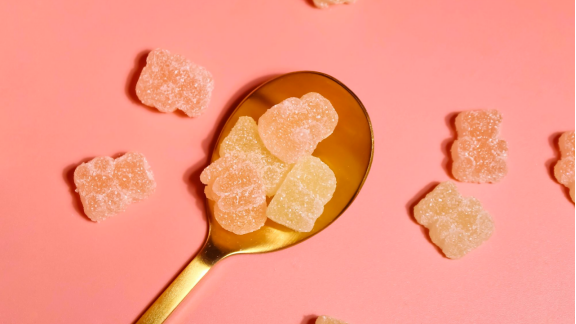
The Two Defects That Drain Gummy Margin
Ask any gummy manufacturing line what drives the highest scrap rate and the answer usually comes down to two recurring defects: sugar or polyol crystallization (the gritty, sandy bite) and surface stickiness (pieces clumping or cold-flowing in the container). Both are immediately obvious to consumers, both generate costly market returns, and both are preventable when formula design aligns with tight process controls. For brand owners and procurement teams, mastering these failure mechanisms is essential not just for auditing contract manufacturers, but for specifying raw ingredient tolerances that keep the line running smoothly.
This technical guide breaks down the physical chemistry behind crystallization and stickiness, explains how to engineer stability directly into your gelatin matrix, and details the exact verification standards to require from both your contract packager and your raw gelatin supplier before scaling commercial batches.
Understanding Crystallization
In gummy confectionery, crystallization occurs when dissolved sugars (sucrose) or polyols (such as erythritol or isomalt) precipitate out of a supersaturated solution into ordered crystalline lattices. The consumer experiences this defect as an unpleasant sandy, gritty bite or opaque white bloom on the surface. Because crystal nucleation and macroscopic growth require molecular mobility over time, this failure frequently emerges weeks into distribution rather than during end-of-line release testing.
Root Causes of Crystallization
- Imbalanced Sugar-to-Syrup Ratio: Insufficient ratio of glucose syrup solids (or high-maltose syrup) to crystalline sucrose; glucose syrup oligosaccharides provide the essential steric hindrance that prevents sucrose molecules from packing into crystals.
- Over-Concentrated Depositing Solids: Evaporating beyond the target Brix during cooking (e.g., depositing above 80–82° Brix), creating severe supersaturation upon cooling.
- Solute Solubility Exceeded (Sugar-Free Formulations): Over-dosing low-solubility polyols like erythritol (ambient water solubility ~37%) beyond their saturation threshold in 76–80° Brix polyol syrups.
- Thermal Cycling in Warehousing: Temperature fluctuations between warm transit and cool storage that induce dissolution-recrystallization cycles (Ostwald ripening).
- Seed Contamination from Reintroduced Scrap: Introducing unmelted starch scrap, dried kettle crusts, or unwashed depositor nozzles that seed immediate crystal growth.
Buyer signal: If a supplier's pilot samples develop surface bloom or sandy bite after 2 to 4 weeks, their solids control or syrup-to-sucrose ratio is unstable. Require a real-time stability sample, not just a fresh one.
Formulation and Engineering Levers Against Crystallization
- Lock the Dry Solids Ratio: Maintain a minimum 55:45 to 60:40 glucose syrup solids-to-sucrose ratio; select a 42–63 DE syrup to maximize viscosity and steric barrier against sucrose alignment.
- Deposit at Target Solids Without Over-Evaporation: Calibrate kettle temperature and vacuum to deposit precisely at 76–79° Brix (for standard gelatin gummies); avoid holding hot mass in the depositor hopper where moisture flashes off.
- Late-Stage Acid Dosing: Introduce acid solutions (e.g., citric/malic) immediately prior to depositing at 70–75°C to preserve gelatin peptide integrity and prevent runaway sucrose inversion into hygroscopic fructose.
- Engineer Polyol Solubility in Sugar-Free Lines: Cap erythritol at 6–8% of total formula, pairing it with maltitol syrup or hydrogenated starch hydrolysates (HSH) to maintain liquid phase stability.
- Screen Scrap and Implement Clean CIP: Reheat and filter all rework scrap through a 60-mesh screen to completely melt crystal remnants before kettle blending.
Understanding Stickiness
Stickiness is the inverse physical failure: an excess of mobile surface moisture or an insufficiently cross-linked polymer network, causing individual gummies to cold-flow and fuse into a single mass. In manufacturing, it reveals itself as mold sticking, clumping in packaging, and failure of oil/wax glazing to form a stable hydrophobic seal. Fundamentally, stickiness stems from either unbalanced water activity (aw exceeding the packaging barrier capacity) or gelatin network failure that allows free water syneresis.
Root Causes of Surface Stickiness
- Incomplete Stoving / Drying: Removing gummies from curing rooms before internal moisture equilibrates to 14–18% (target aw between 0.58 and 0.65).
- High Environmental Humidity: Packaging in unconditioned pack-off rooms (RH >45%), where hygroscopic surface sugars draw moisture directly from ambient air.
- Gelatin Thermal Degradation or Low Bloom: Prolonged holding in depositor hoppers above 75°C, or using sub-spec Bloom gelatin that yields weak triple-helix junction zones, resulting in water weeping (syneresis).
- Excess or Misaligned Humectants: High dosages of low-molecular-weight polyols (sorbitol, glycerol) that lower product equilibrium relative humidity (ERH) below warehouse RH, driving ambient moisture absorption.
- Starch Molding Moisture Imbalance: Depositing into starch trays with moisture above 7–8%, or improper mineral oil / carnauba wax polishing application.
Margin leak: Sticky gummies force operators into heavy dusting with starch or sugar to prevent line jams. This band-aid fix clouds the product, compromises label transparency, and fails to stop post-packaging clumping. The lasting cure lies in drying curves, surface glazing chemistry, and structural gelatin Bloom selection — not in masking the defect with excess powder.
Prevention Levers
- Engineer the drying stage for a target moisture, not a fixed time.
- Match gelatin bloom and dosage to the water and sweetener load.
- Balance humectants so they hold moisture internally, not on the surface.
- Control plant and warehouse humidity; use barrier packaging in humid markets.
- Validate mold release and de-molding temperature.
The Role of Gelatin Grade and Dosage
Gelatin is the structural backbone of most gummies, so its grade and dosage sit at the center of both defects. A higher Bloom gelatin gives more set per gram, letting you lower water and humectant — which simultaneously reduces stickiness and tightens the matrix against crystallization. But push dosage too high and you get a rubbery chew no one wants. The right answer is product-specific, which is exactly why you need a supplier who tunes the grade to your formula.
What to Require From Your Manufacturing Partner
When you brief a contract manufacturer for gummies, turn these failure modes into concrete questions:
- Do you measure and log soluble solids / Brix and final moisture on every batch?
- What is your drying protocol — time-based or moisture-targeted?
- Can you provide real-time (not just accelerated) stability showing no grit at 8–12 weeks?
- Which gelatin bloom and dosage do you recommend for my sweetener system?
- How do you control plant humidity and prevent seed-crystal contamination?
- What is your non-conforming batch handling if crystallization or stickiness appears?
Decision rule: a supplier who can answer all six with data — not reassurance — is the one who will keep your defect rate low and your repeat orders high.
A Practical Quality Gate
Before scaling, run a small lot and hold it at stress temperature/humidity for two weeks alongside a normal-condition sample. Score both for grit and stickiness. If either fails, you have found your control gap before it reaches a truckload of complaints. This single gate has saved more gummy programs than any premium ingredient ever will.
Frequently Asked Questions
Q: Why do my gummies get gritty weeks later?
A: Crystallization from under-inversion or drifting solids typically appears in storage, not on day one. A real-time stability check catches it before launch.
Q: Is stickiness caused by too much gelatin?
A: Usually the opposite — too little structure or too much surface moisture. The fix is normally the drying curve and humectant balance, not more gelatin.
Q: Can a higher Bloom gelatin help both defects?
A: Yes. More set per gram lets you lower water and humectant, tightening the matrix against crystals and reducing surface stickiness — but balance the chew.
Q: How should a buyer vet a gummy manufacturer?
A: Ask for batch-logged Brix and moisture, a moisture-targeted drying protocol, and real-time stability data. Reassurance without data is a red flag.
Key Takeaways
- Crystallization and stickiness are the two gummy defects that drive returns — both are preventable.
- Crystallization is solved by solids/inversion control, stable storage, and anti-crystal blends.
- Stickiness is solved by moisture-targeted drying, humectant balance, and the right gelatin grade.
- Gelatin bloom and dosage sit at the center of both; tune them to the formula, not a default.
- Require batch-logged Brix/moisture and real-time stability data when choosing a manufacturer.
References & Further Reading
- U.S. FDA — 21 CFR 184.1976: GelatinGelatin is generally recognized as safe (GRAS) for food use — the foundational gummy gelling agent.
- U.S. FDA — High-Intensity SweetenersRegulatory status of sugar alcohols (erythritol, isomalt) and other polyols used to prevent crystallization.
- FSSC 22000 — Food Safety CertificationGFSI-benchmarked scheme to require from contract packagers and raw gelatin suppliers before scale-up.

Post time: Oct-28-2026

