


The standards, limits, and documentation that define safe edible gelatin — and the gaps buyers must close before putting it in a food product.
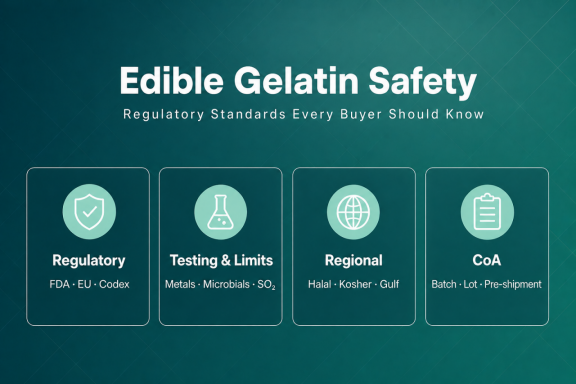
Safety Is a Documentation Discipline
Edible gelatin is a widely used, naturally derived protein, but in regulated food markets, safety must be supported by documented evidence. Buyers who focus only on price without verifying compliance may face retailer rejection, customs delays, or other problems caused by missing documentation or non-compliant contaminants. Reliable sourcing therefore depends on knowing which standards apply, which limits matter, and which documents should accompany each lot.
The Core Standards Bodies
Regulatory requirements for edible gelatin vary by market, although many follow similar principles for purity, hygiene, and contaminant control. In the United States, gelatin may be used in food under applicable FDA requirements, while technical specifications may also be referenced depending on the application. In the European Union, gelatin is subject to EU food hygiene, traceability, and contaminant requirements. Other markets may apply national food standards or requirements that reference Codex Alimentarius principles. Understanding the framework for each target market helps buyers identify the relevant limits and documentation requirements.
What Compliance Looks Like in Practice
Compliance does not depend on a single certificate. It is supported by a combination of raw-material controls, hygienic production, testing, traceability, and appropriate documentation. A qualified supplier should manage these areas through established procedures and be able to provide supporting evidence when required.
- Approved raw-material sourcing from animals fit for human consumption.
- Hygienic extraction and purification under a documented food-safety system (HACCP/GMP).
- Control of heavy metals, microbial load, and residual chemicals to published limits.
- Control of animal species and processing conditions where halal, kosher, or other source-specific requirements apply.
- Accurate product documentation covering grade, gel strength, and relevant certification or labeling information.
Heavy Metals, Microbials, and Purity
The limits that matter for food-safety control are concrete and measurable. Depending on the applicable requirements, these may include limits for heavy metals such as lead, arsenic, cadmium, and mercury; microbiological indicators and pathogens such as total plate count, E. coli, and Salmonella; and residues such as sulfur dioxide. A batch-specific Certificate of Analysis (CoA) is an important part of this verification process. It should show the relevant test results and specifications needed to confirm that the lot meets the agreed requirements. If critical safety parameters are missing or unclear, buyers should request additional supporting information before acceptance.
| Parameter | Why it matters | What good looks like |
|---|---|---|
| Heavy metals | Chronic toxicity risk if above limit | Reported per lot, within published maxima. |
| Microbial load | Spoilage and foodborne-illness risk | Within food-grade limits; pathogens absent. |
| Residual SO2 | Allergen/sensitivity and label compliance | Within the applicable limit; reported or declared where required. |
| Species purity | Religious and label compliance | Confirmed free of prohibited species. |
| Gel strength & moisture | Product functionality and storage consistency | Within the agreed product specification. |
Regional Requirements You Cannot Ignore
Beyond common contaminant controls, individual markets may add their own requirements. Halal and kosher requirements may affect raw-material source and processing controls for products intended for specific consumers or markets. The EU places strong emphasis on contaminant control and traceability, while some markets in the Gulf and Southeast Asia may require recognized halal certification for certain food products or commercial channels. Buyers serving multiple regions should map the requirements of each market and confirm that the selected product and documentation are suitable for the intended destination.
The CoA as a Key Verification Document
A batch-specific CoA is one of the most important documents in edible-gelatin procurement. It should identify the lot, reference the agreed specification or applicable requirement, and report the relevant test results. Together with traceability records and other supporting documentation, it helps buyers demonstrate that the received material meets the required quality and safety criteria. The CoA should be received before or with shipment and archived against the corresponding lot number for efficient future verification.
“Food grade” alone is not sufficient evidence of compliance. Buyers should confirm that appropriate batch documentation is available and that critical safety parameters are evaluated against the applicable specification or regulatory requirements.
Common Gaps Buyers Miss
- Assuming a company certificate covers every grade and market — scope and validity matter.
- Accepting CoAs that provide insufficient detail for the buyer’s verification requirements.
- Failing to confirm halal, kosher, or other source-specific requirements before supplying the product to a market where they apply.
- Losing the paper trail between lot number and certificate during warehouse handling.
- Overlooking residue declarations (e.g., sulfur dioxide) that some labels must disclose.
Choosing a Safety-First Supplier
A reliable edible-gelatin supplier integrates food safety into sourcing, production, testing, documentation, and traceability. Batch CoAs, current certifications, and traceability records should be readily available when required. This level of documentation helps buyers respond more efficiently to audits, customer reviews, and regulatory checks.
Gelken provides edible gelatin with batch-specific CoAs, product traceability, and relevant certification documentation according to product and market requirements. Contact us for the technical and compliance documents needed to evaluate gelatin for your food application.
Frequently Asked Questions
Q: Does the regulatory status of gelatin remove the need for supplier verification?
A: No. Regulatory acceptance of gelatin as a food ingredient does not replace batch-level quality control, traceability, or supplier documentation. Buyers should still verify that the material meets the requirements applicable to their product and market.
Q: What should my CoA be based on?
A: It should reflect the agreed product specification and any applicable regulatory or customer requirements for the target market. Buyers should confirm these requirements with the supplier before shipment.
Q: Do I need halal or kosher certification for general food applications?
A: It depends on the target market, customer requirements, and intended consumer group. Buyers should confirm these requirements before selecting the gelatin source and certification scope.
Q: What heavy metals should be reported?
A: The relevant heavy metals depend on the applicable specification or regulatory requirements. Commonly controlled elements may include lead, arsenic, cadmium, and mercury. Buyers should confirm the required limits and reporting format for their target market.
Key Takeaways
- Edible gelatin safety should be supported by documented controls and verification.
- Understand the regulatory, specification, and documentation requirements of each target market.
- Use batch CoAs together with traceability and supporting documentation to verify compliance.
- Choose a supplier that can provide consistent, traceable safety and quality documentation.

Post time: Sep-15-2026

