


A practical guide to matching gelatin specifications, quality documentation, and supply capability to your confectionery formulation and production process.
How Supplier Selection Supports Consistent Confectionery
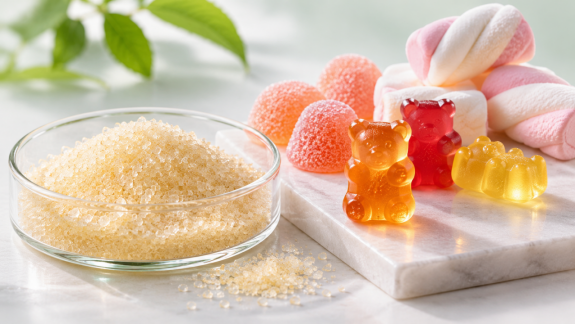
ISelecting a confectionery gelatin supplier starts with the texture and processing requirements of your product. In gummies, marshmallows, pastilles, and jelly confectionery, gelatin contributes to gel structure or foam stability. Its performance depends on the grade, concentration, recipe, and production conditions. A useful specification connects these requirements with measurable acceptance limits. Buyers should assess application results alongside batch consistency, traceability, and delivery capability. This approach helps establish a material that performs reliably on the production line and provides a clear basis for comparing suppliers and managing future orders.
For a new product, share your target texture, process conditions, and market requirements with Gelken. Use the proposed gelatin specification and representative samples to evaluate suitability in your own formulation before approving commercial supply.
Gel Strength as a Starting Point for Selection
Gel strength, expressed as a Bloom value, compares gelatin grades under standardized conditions. The GME method uses a 6.67% gelatin gel conditioned at 10°C for 17 ± 1 hours. A standard 12.7 mm plunger penetrates 4 mm, and the measured force is reported in grams Bloom. This laboratory value provides a common basis for specification and batch comparison. Buyers should agree the method and edition, including preparation and conditioning requirements, so results from supplier and customer laboratories are comparable. Finished confectionery texture should then be assessed in the actual recipe.
A higher gel strength may allow a lower gelatin dosage in a particular formulation. Establish the relationship through trials that also account for sugar composition, soluble solids, pH, and thermal history. Compare setting behavior, bite, elasticity, and storage performance at candidate dosages, then confirm the selected grade under production conditions.
Other Specifications That Affect Processing and Quality
- Viscosity: agree a range, test concentration, temperature, method, and unit; verify syrup flow separately under depositing conditions.
- Particle size: define the sieve standard and distribution, then check hydration with your mixing conditions.
- Moisture: set an acceptance limit to support consistent solids input and appropriate storage control.
- Microbiology: agree relevant organisms, limits, sampling plans, and testing frequency for the intended market and use.
- Chemical and sensory quality: define applicable contaminant and sulfur dioxide limits, plus relevant pH, color, clarity, and odor requirements.
- Batch consistency: review gel strength and viscosity trends across representative commercial lots against agreed tolerances.
Compliance and Traceability Documentation
Build a documentation package around the destination market and approved ingredient specification. Request a lot-specific Certificate of Analysis (CoA), animal-source and origin information, and applicable BSE/TSE documentation. Maintain Halal or Kosher certificates where required, checking the covered product, manufacturing site, validity, and market acceptance. Supplier declarations and certificates can be controlled separately from the CoA. Agree which results are reported for each lot and which requirements are supported by a documented periodic testing program.
| Specification | Why it matters | What to confirm |
|---|---|---|
| Gel strength | Grade comparison and gel performance | Agreed range and test method |
| Viscosity | Solution flow and processing | Range, method, conditions, unit |
| Particle size | Dispersion and hydration | Sieve standard and distribution |
| Microbiology | Food safety controls | Limits, sampling, test frequency |
| Source and traceability | Market and customer requirements | Origin, species, applicable documents |
| Batch consistency | Repeatable application performance | Commercial lot trends and tolerances |
Questions to Put to Every Supplier
- What gel strength range, test method, and testing frequency apply to this grade?
- What viscosity and particle-size tolerances can you maintain across commercial lots?
- Which CoA results are tested per lot, and which rely on periodic verification?
- Which source, BSE/TSE, Halal, or Kosher documents apply to the proposed grade?
- How will you notify us of changes to source, specification, or manufacturing process?
- How are nonconforming lots investigated, and what corrective actions and replacement timelines can be agreed?
- Can you provide representative samples for trials in our formulation and production process?
Matching the Grade to the Confectionery Format
For gummies and pastilles, evaluate gel strength and viscosity against the desired bite, depositing conditions, setting time, and drying process. Marshmallows also require suitable aeration and foam stability, which should be checked alongside density and texture. Select the grade through application trials covering the intended storage conditions. In gummies containing collagen peptides, assess the peptide dose within the complete recipe because it changes the solids balance and can affect texture and flavor. Gelatin and collagen peptides should each be specified according to their role in the formulation.
Assess supply continuity before placing routine orders. Confirm available capacity for your grade, realistic lead times, minimum order quantities, and contingency arrangements. Review the qualification needed for any alternative source. These details help align purchasing schedules and inventory with production demand.
Frequently Asked Questions
Q: What Bloom should I specify for gummies?
Commonly use about 200–280 Bloom; the exact value depends on your target firmness and dosage. Ask your supplier to recommend a band and validate it in a trial.
Q: Is Bloom the only spec that matters?
No. Viscosity, particle size, moisture, microbiology, heavy metals, and batch-to-batch consistency all determine whether your product is repeatable and compliant.
Q: How can I verify a reported Bloom value?
Confirm the agreed method, sample conditioning, and equipment checks. If results differ, compare retained samples using the same protocol, with an independent laboratory where appropriate.
Key Takeaways
- Use gel strength and viscosity together to shortlist grades, then validate dosage and texture in the recipe.
- Agree particle size, moisture, sensory quality, and applicable microbiological and chemical requirements.
- Review each lot’s CoA and maintain current source and certification documents separately.
- Match the grade to the confectionery format, equipment, and intended storage conditions.
- Compare supplier consistency, change control, delivery capability, and total production cost.
References
- FDA — Gelatin, 21 CFR §184.1976 (GRAS)U.S. FDA food-additive regulation establishing gelatin as generally recognized as safe.
- FSSC 22000 — Food Safety CertificationGlobally recognized food-safety certification scheme used to audit gelatin suppliers and contract manufacturers.
- EFSA — Novel Food & Gelatin/Collagen TopicsEuropean Food Safety Authority scientific resources on gelatin, collagen peptides and related food ingredients.

Post time: Nov-05-2026

